
Introduction
The field of artificial intelligence (AI) is rapidly evolving, reshaping industries and altering the way we interact with technology. At the forefront of this transformation are various types of models, including Large Language Models (LLMs), Small Language Models (SLMs), and Small Action Models (SAMs). As these models develop, agents—intelligent systems that utilize these technologies—are redefining the capabilities of AI, making it more accessible and efficient for diverse applications.
According to a recent report by OpenAI, the use of LLMs has surged, with an estimated 60% of businesses integrating AI into their operations as of 2023. This trend emphasizes the need for models that can cater to different requirements, from comprehensive data processing to lightweight, task-oriented applications.
Understanding the Models
Large Language Models (LLMs)
Large Language Models, such as GPT-4 and BERT, are designed to understand and generate human-like text based on vast datasets. These models utilize billions of parameters—GPT-4 has approximately 175 billion parameters—enabling them to capture intricate language patterns, context, and semantics effectively.
Key Features:
- Natural Language Understanding (NLU): LLMs excel at comprehending text, making them ideal for tasks such as sentiment analysis and language translation.
- Text Generation: They can generate coherent and contextually relevant text, useful for content creation and conversational agents.
- Fine-Tuning Capabilities: Users can fine-tune LLMs on specific tasks or industries, enhancing their performance in targeted applications.
Trends:
The adoption of LLMs in businesses has surged, with 60% of companies reporting increased investment in AI technologies in 2023. This trend indicates a growing reliance on LLMs for enhancing customer engagement and automating communication.
Small Language Models (SLMs)
Small Language Models are engineered for efficiency and rapid performance in resource-constrained environments. While they may not have the extensive capabilities of LLMs, they retain sufficient functionality for many applications. For instance, models like DistilBERT offer 60% faster inference times and are 40% smaller than traditional LLMs, making them suitable for mobile and embedded systems.
Key Features:
- Resource Efficiency: SLMs require less computational power, allowing for deployment on devices with limited processing capabilities.
- Faster Response Times: Their streamlined architecture enables quicker responses, making them ideal for real-time applications.
- Ease of Integration: SLMs can easily fit into existing systems, enhancing functionality without significant overhauls.
Trends:
The use of SLMs is growing in sectors like mobile applications and edge computing. For example, language learning platforms such as Duolingo leverage SLMs to provide efficient and effective educational experiences without overwhelming users.
Small Action Models (SAMs)
Small Action Models focus on real-time decision-making and task execution, distinguishing them from language-centric models. SAMs are particularly effective in scenarios requiring immediate responses, such as robotics and automation.
Key Features:
- Real-Time Processing: SAMs can analyze input and execute tasks in real time, making them ideal for dynamic environments.
- Adaptability: These models can learn from user interactions and adjust their behavior accordingly, enhancing user experience.
- Task-Oriented Design: SAMs are built to perform specific actions based on predefined criteria, streamlining operations in various applications.
Trends:
The adoption of SAMs is increasing in industries like manufacturing and smart home technology. For instance, smart home devices that utilize SAMs can adjust settings based on user habits, leading to a 25% increase in energy efficiency.
In summary, understanding these models—LLMs, SLMs, and SAMs—highlights their distinct capabilities and trends shaping the AI landscape. Each model serves a unique purpose, catering to various applications and market needs, which is critical as businesses strive to leverage AI effectively.
The Power Law of Generative AI
The Power Law of Generative AI refers to the phenomenon where a small number of models or applications account for a disproportionate share of impact and usage in the field. This trend is evident in how generative AI tools—such as Large Language Models (LLMs) and image generation systems—exhibit exponential growth in capabilities and adoption, often driven by a select few innovations.
Key Features of the Power Law
- Disproportionate Impact: A few high-performing models, like GPT-4 or DALL-E, dominate the landscape, achieving widespread adoption and generating significant value. For example, GPT-3 generated over 4.5 billion words per day shortly after its launch, showcasing its immense reach.
- Resource Concentration: Resources (data, compute power, and talent) are increasingly concentrated in a few organizations, leading to a few models being highly optimized while others lag behind. This has resulted in a winner-takes-all dynamic in the AI marketplace.
- Network Effects: Successful models benefit from network effects, where increased usage leads to more data for training, enhancing performance further. This cycle creates a feedback loop that amplifies the advantages of leading models.
Trends in Generative AI
- Rapid Advancements: The pace of development in generative AI is accelerating. Breakthroughs in algorithms and architectures, like transformers, have led to models that perform complex tasks previously thought impossible. The release of models like ChatGPT has transformed user expectations regarding AI capabilities.
- Wider Applications: Generative AI is expanding into various domains, including content creation, design, music, and even code generation. For instance, platforms like OpenAI’s Codex can write code based on natural language prompts, streamlining software development.
- Ethical Considerations: With the power and reach of these models comes significant ethical implications. Issues such as bias, misinformation, and environmental impact of large-scale model training are increasingly scrutinized. Organizations are now prioritizing ethical guidelines and responsible AI use.
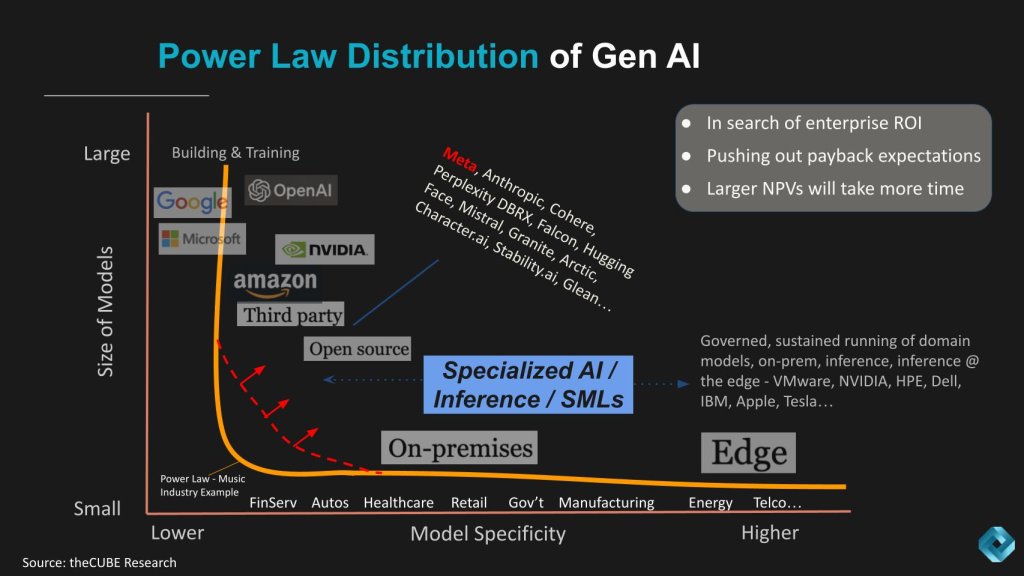
In this illustration, the long tail represents model specificity, and the Y axis represents the model size. This is different from classical power laws in that the red-colored torso will be pulled up and to the right by the third-party models and open-source movement. For reasons that will become clear in a moment, we have highlighted Meta Platforms Inc. in Red. Overall, though slowly, this picture is emerging as we anticipated, with enterprises seeking return on investment, lowering expectations for payback, and realizing that achieving AI excellence requires more than just a series of API calls to OpenAI models.
ETR Survey on AI Investment: Key Insights and Trends
The ETR (Emerging Technology Research) survey on AI investment provides a comprehensive overview of how organizations are allocating resources towards artificial intelligence technologies. This survey captures insights from various industries, highlighting trends, challenges, and expectations regarding AI adoption.
Key Findings
- Increased Investment in AI
- Investment Growth: A significant percentage of companies report increasing their AI budgets. In the latest survey, 60% of respondents indicated they plan to boost their AI investments in the coming year, reflecting a growing recognition of AI’s potential to drive innovation and efficiency.
- Primary Areas of Investment
- Natural Language Processing (NLP): A major focus area, with 45% of companies investing in NLP technologies to enhance customer interactions and automate communication.
- Machine Learning (ML) and Automation: Approximately 50% of respondents are allocating funds to ML solutions, emphasizing the importance of automation in operational efficiency.
- Data Analytics: About 40% are prioritizing investments in data analytics platforms to harness insights from large datasets.
- Challenges in AI Adoption
- Talent Shortage: Over 70% of organizations reported difficulty in finding skilled professionals to implement AI solutions, which remains a significant barrier to effective adoption.
- Integration with Existing Systems: Many companies face challenges integrating AI technologies with their legacy systems, with 65% highlighting this as a critical concern.
- Expected Returns on Investment
- Companies anticipate substantial ROI from their AI investments. 75% of respondents expect to see improvements in operational efficiency, while 60% forecast enhanced customer satisfaction as a direct result of AI integration.
- Future Trends
- Increased Focus on Ethical AI: A growing number of organizations are committing to ethical AI practices, with 50% emphasizing the importance of bias reduction and transparency in their AI initiatives.
- Hybrid Models: Many respondents express interest in developing hybrid models that combine traditional AI methods with emerging technologies, such as quantum computing and edge AI.
The open-source movement is having a big impact on the market. The ETR data below shows the Net Score, or spending momentum, on the vertical axis and account overlap in the dataset of over 1,600 information technology decision makers on the X axis. Overlap serves as a stand-in for market saturation. At 40%, the red line indicates an extremely high velocity of expenditure.
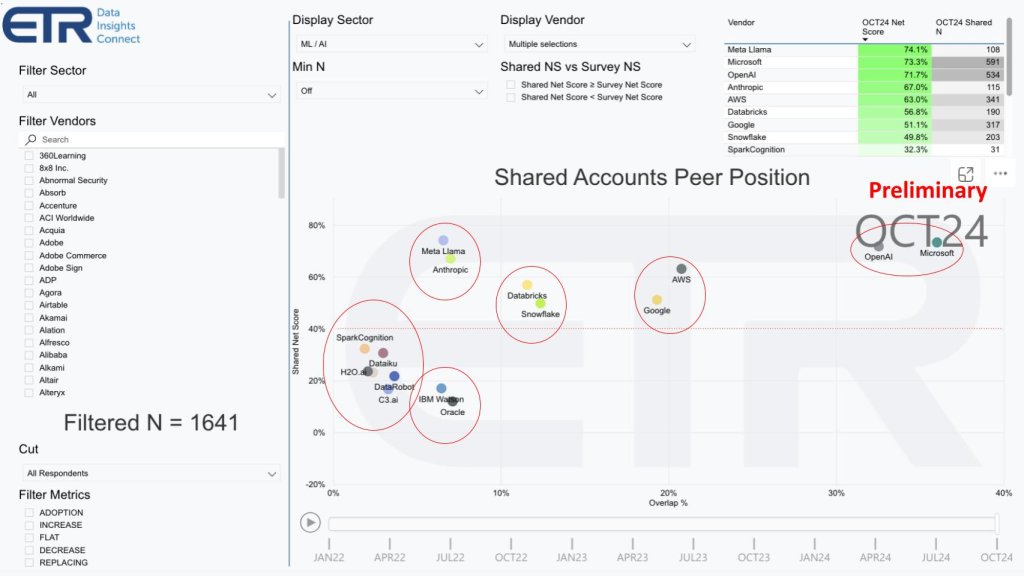
Examine Meta. It has already eclipsed Microsoft Corp. and OpenAI as the LLM with the strongest spending momentum, with a 74% Net Score. Though we point out that enterprises would pay for personnel (skills), infrastructure, and services to deploy open-source models, the poll is assessing adoption in the instance of an ostensibly “free” open-source offering like Llama.
These businesses and associates are represented by the red circles in the diagram. Alright, let’s begin with Anthropic and Meta. As we previously mentioned, the open-source and third-party representatives drag the power law’s torso to the right.
The early pioneers of AI and machine learning, including SparkCognition Inc., DataRobot Inc., C3 AI Inc., Dataiku Inc., and H2O.ai Inc., are depicted in the leftmost circle. Below that, on the Y axis, but with a greater degree of market penetration, we display the large, established businesses, which are represented by AI players IBM Corp. with Watson and Oracle Corp.
The two stand-ins for the contemporary data stack, Databricks Inc. and Snowflake Inc., are then displayed. both in the game as well. Next, AWS and Google, the two companies who initiated the modern AI movement, are competing with Microsoft and OpenAI for second place in mindshare and marketshare in the upper right corner. They really are extraordinary.
the current stage of technology change is going through a typical disillusionment moment, in which expectations are leveling out and hype has marginally exceeded reality. We think that when the market modifies expectations and tactics, there will be a brief slowdown followed by a fresh upsurge in growth and acceptance.
Key observations include:
- Open-source momentum: The increasing adoption and velocity of models such as Llama are driven by the momentum behind open source. The ability to customize, greater transparency and better integration across models provide more visible advantages relative to proprietary offerings from OpenAI and Microsoft, which led with first-mover advantage.
- Need for transparency and customization: In our opinion, enterprises are realizing the necessity for higher levels of transparency and customization in AI models. This has prompted greater interest in solutions that offer such capabilities and is challenging first movers.
- Shifting ROI expectations: We are observing a shift in ROI timelines. Initially, organizations were optimistic about quick ROI within three to six months. However, expectations are now extending beyond a year, indicating a more realistic approach to AI implementation.
- Incremental value through integration: In our view, organizations can derive substantial incremental value by adopting generative AI features embedded in their existing products, rather than investing in building bespoke generative AI systems from scratch. Current research however continues to indicate high levels of experimentation with bespoke systems. We believe over time this trend will decline and embedded AI will be the dominant model.
- AI as a universal enhancer: In our view, this era of AI resembles the impact of the internet and has the potential to be a tide that lifts all ships, offering widespread benefits across industries.
We anticipate continued strong AI investment and innovation as organizations leverage open-source models and integrate generative AI features into existing products, leading to significant value creation and industry-wide advancement.
Evolution of Small Action Models Towards Generative AI Multi-Agent Systems
Small Action Models (SAMs) are designed for real-time decision-making and task execution, often operating in constrained environments. Their evolution towards Multi-Agent Systems (GIMAS) represents a significant advancement in AI, enabling more complex interactions, adaptability, and collaborative problem-solving among multiple agents.
Generative AI Multi-Agent Systems (GAMAS) represent an innovative evolution in AI, where multiple generative models work collaboratively to produce content, solve problems, or enhance decision-making. Unlike traditional multi-agent systems, which focus primarily on task execution and coordination, GAMAS leverage the creative capabilities of generative AI to operate in dynamic and interactive environments.
Capabilities of Generative AI Multi-Agent Systems
- Collaborative Content Creation
- Multiple agents can work together to generate cohesive and contextually relevant content across different mediums—text, images, audio, or video. For example, a team of generative agents could collaboratively create a screenplay, with one agent developing the dialogue while another focuses on visual elements.
- Dynamic Problem-Solving
- GAMAS can engage in complex problem-solving scenarios by pooling their generative capabilities. For instance, in a business setting, agents could analyze market trends and collaboratively generate strategic recommendations based on diverse data inputs.
- Personalized User Interactions
- By leveraging user data and preferences, generative agents can tailor responses and content in real-time, creating highly personalized experiences. For example, in customer service, multiple agents could generate responses that align with a customer’s specific history and preferences.
- Adaptive Learning and Evolution
- Generative AI agents can learn from interactions and feedback, evolving their outputs over time. This adaptability enables them to better meet user needs and improve the relevance and quality of the generated content.
- Multimodal Generation
- GAMAS can seamlessly integrate different types of media (text, images, audio) to produce rich, multimedia outputs. For example, a generative agent could create an educational video by generating script content, visuals, and voiceovers collaboratively.
- Simulations and Scenario Testing
- These systems can create simulated environments for training or testing purposes, allowing organizations to explore various scenarios. For instance, GAMAS can simulate customer interactions to refine service strategies or test marketing campaigns.
- Enhanced Creativity
- By leveraging diverse generative models, GAMAS can introduce novel ideas and concepts that a single agent might not conceive. This collaborative creativity can lead to innovative solutions in fields like design, advertising, and entertainment.
Applications of Generative AI Multi-Agent Systems
- Entertainment and Media
- GAMAS can revolutionize content creation in film, gaming, and advertising by generating dynamic narratives, characters, and interactive experiences based on audience preferences.
- Education
- In educational environments, generative agents can create personalized learning materials, quizzes, and interactive tutorials tailored to individual learning styles and paces.
- Healthcare
- GAMAS can assist in generating treatment plans, simulating patient interactions, and creating educational resources for patients, thereby enhancing care delivery and patient engagement.
- Marketing and Branding
- These systems can generate targeted marketing campaigns, craft social media content, and create visuals that resonate with specific demographics, improving engagement and effectiveness.
- Research and Development
- In R&D, GAMAS can synthesize vast amounts of research data to generate hypotheses, design experiments, and propose innovative solutions to complex problems.
Conclusion
Generative AI Multi-Agent Systems open new horizons for collaboration, creativity, and adaptability in AI applications. By harnessing the collective power of generative models, these systems can produce high-quality content, solve complex problems, and personalize interactions in ways previously unimaginable. As the technology continues to develop, GAMAS will likely play a crucial role in transforming industries and enhancing human experiences.
