Build and Sell APIs with AI: The Blueprint for Creating Lucrative Digital Products
Unlocking New Opportunities in the API Economy
In the rapidly evolving digital landscape, APIs (Application Programming Interfaces) have become the backbone of interconnected systems and seamless data exchange. They act as bridges between applications, enabling them to communicate and share information effortlessly. As businesses increasingly rely on APIs to drive innovation, the demand for these digital assets is skyrocketing.
This presents a unique opportunity for those with the skills and knowledge to build and sell APIs. And when combined with the power of AI (Artificial Intelligence), the possibilities for creating valuable and innovative API products are endless.
Here’s a comprehensive guide that empowers you to embark on this exciting journey:
Understanding APIs and AI: A Perfect Synergy
- APIs: The Gateways to Digital Collaboration
- Function as intermediaries that enable different applications to “talk” to each other.
- Allow for seamless data exchange and integration between systems.
- Play a crucial role in web development, mobile apps, cloud services, and IoT (Internet of Things).
- AI: The Engine of Intelligent Automation
- Simulates human intelligence to perform tasks like learning, reasoning, and problem-solving.
- Can be integrated into APIs to enhance their capabilities and deliver smarter solutions.
- Examples include:
- AI-powered chatbots for customer support within APIs.
- Machine learning algorithms for predictive analysis and personalization.
- Image and language processing for content moderation and translation services.
Creating Profitable API Products with AI
-
Identify a Market Need:
- Conduct thorough market research to uncover challenges and pain points that can be addressed with APIs.
- Analyze existing API marketplaces (e.g., RapidAPI, API Marketplace) to identify gaps and opportunities.
- Consider niche markets with specific needs or underserved industries.
-
Design a Valuable API:
- Define clear functionalities and user-friendly interfaces.
- Prioritize security, scalability, and reliability.
- Incorporate AI capabilities that differentiate your API from competitors.
- Examples:
- AI-powered sentiment analysis API for social media monitoring.
- Machine learning-based product recommendation API for e-commerce platforms.
- Natural language processing API for content summarization and translation.
-
Choose the Right Development Tools:
- Select a suitable framework or library based on your programming expertise and project requirements.
- Popular options include Python (Flask, Django), Node.js, and Java (Spring Boot).
- Consider cloud-based API development platforms (e.g., Amazon API Gateway, Google Cloud Endpoints) for simplified deployment and management.
-
Integrate AI Capabilities:
- Leverage AI libraries and frameworks (e.g., TensorFlow, PyTorch) to add intelligent features.
- Train machine learning models on relevant datasets to power predictions and analytics.
- Explore cloud-based AI services (e.g., Amazon SageMaker, Google AI Platform) for pre-built models and infrastructure.
-
Test Thoroughly and Securely:
- Conduct rigorous testing to ensure API functionality, reliability, and security.
- Implement robust authentication and authorization measures.
- Protect sensitive data with encryption and access controls.
-
Deploy and Market Your API:
- Choose a suitable hosting platform (e.g., cloud-based providers, self-hosting).
- List your API on popular marketplaces to reach potential customers.
- Create clear documentation and tutorials to facilitate adoption.
- Engage in active marketing and community outreach.
Monetization Strategies:
- Subscription Models: Offer different pricing tiers based on usage limits or features.
- Pay-per-Use Models: Charge based on the number of API calls or data volume.
- Freemium Models: Provide a basic version for free with paid upgrades for advanced features.
- Partnerships and Integrations: Collaborate with other businesses to expand reach and create value-added services.
Building a Sustainable API Business
- Provide Excellent Customer Support: Offer prompt and helpful assistance to developers.
- Continuously Improve Your API: Gather feedback, iterate on features, and stay ahead of trends.
- Build a Strong Brand and Community: Establish credibility and attract a loyal user base.
Example
Suppose a programmer wants to develop social media management software like Buffer or Hootsuite.
In that case, he will need access to Facebook, Twitter, Pinterest, and other social platforms directly from his code so he can publish, schedule, access analytics, and do other stuff from his own application.
But this is not possible by default because if you want to post on social platforms, you must use their interface. So what to do?
How do social media management tools access platforms like Facebook and Twitter?
Here, the API solves this issue and acts as a gateway or a broker between the programmer and the target platform.
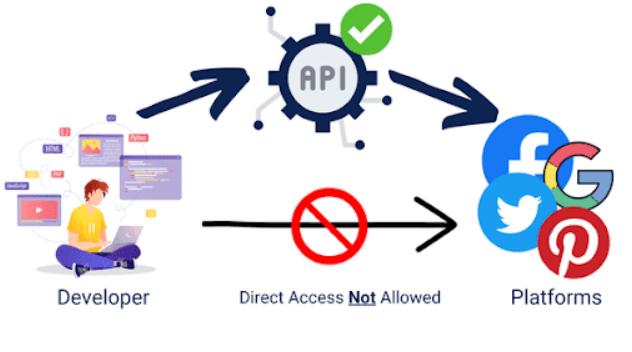
For example, Facebook allows programmers to access Facebook through Facebook API, just like Twitter, Pinterest, Google, and many other platforms.
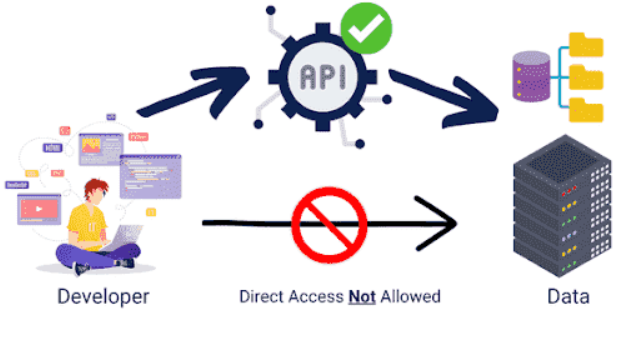
Another Example of APIs is allowing programmers to access data on a specific server or database.
We can’t give programmers public access to our servers and databases. So we created an API that can manage and handle this securely.
And if you like reading technical definitions, here we are:
API stands for Application Programming Interface. It is a set of rules and protocols for accessing a web-based software application or web tool. Simply, it allows communication between different software systems and enables them to exchange data.
I think that’s enough; hopefully, you’ve grasped the concept of APIs.
The API Business Blueprint
Let’s Understand The Idea behind making money with APIs.
How can we, as simple human beings, establish an online income stream with APIs?
We mainly have 2 ways to make money with APIs:
- Build and Sell APIs
- Consume an API and Build Your own tool or SAAS.
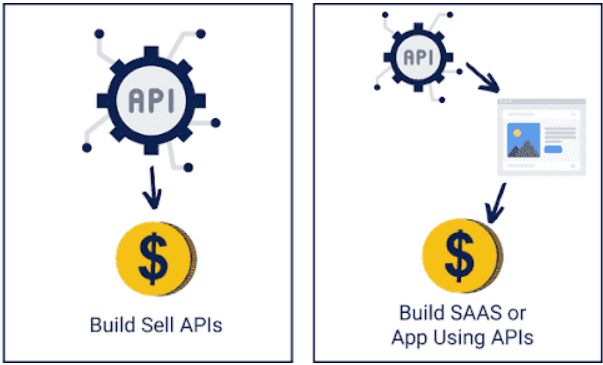
1. Build and Sell APIs.
And this is what this post is all about.
The idea is simple. You will find an idea that can solve a specific problem for certain people.
Then, You will build and Host the API. After that, you will List the API on Marketplaces like RapidAPI. Then, you will promote the API. And you will establish a recurring monthly income.
The Idea may seem complicated, but it is not. Believe it or not, you can do this every month!
2. Develop a tool, app, or SAAS based on APIs.
The second method is to build a tool’s website based on APIs.
This website can be a free tool or a SAAS subscription-based website. Or even a mobile app!
For example, the Hashtag Generator Tool is built on top of the Hashtagy API.
This method is out of the scope of this post.
Let’s now get to our main point, the whole step-by-step strategy:
Step 1: API ideas
APIs are like any business. You need to find a profitable idea and build an API around it. Here are the 3 top strategies I use:
Strategy #1: Market Analysis
You can go to websites like RapidAPI, search for a specific niche like Domain Authority, and check for some APIs, to help you brainstorm a couple of ideas.
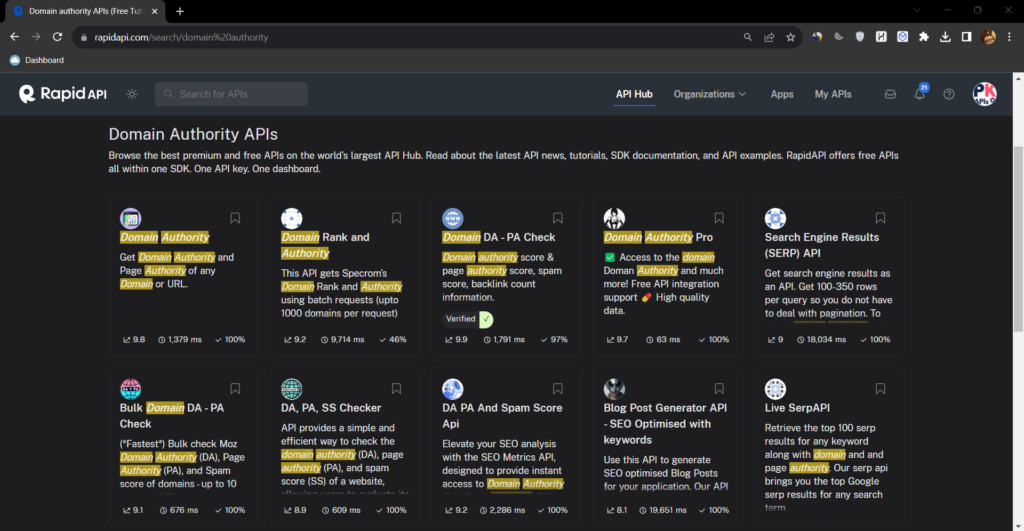
Choose APIs with high popularity and low service levels/functionality that need improving. Then, you can build a new API with a topic already in demand with improved stats.
Strategy #2: Combining Multiple Endpoints
This strategy is about using multiple endpoints in the same API to create another API.

Then, by understanding this concept, you can create complex APIs combining a ton of endpoints.
Strategy #3: Using AI
The idea here is about using the power of Artificial Intelligence to build APIs. There are 2 methods that you do this:
- Reverse Technique: Reverse Engineering APIs with AI and create a new one.
- Function Chaining: You can use it to create 100s of APIs easily!
Step 2: Building APIs
We mainly have two methods, you can either build the API by coding if you have the specific expertise to do so, or you can use no-code tools like Xano.
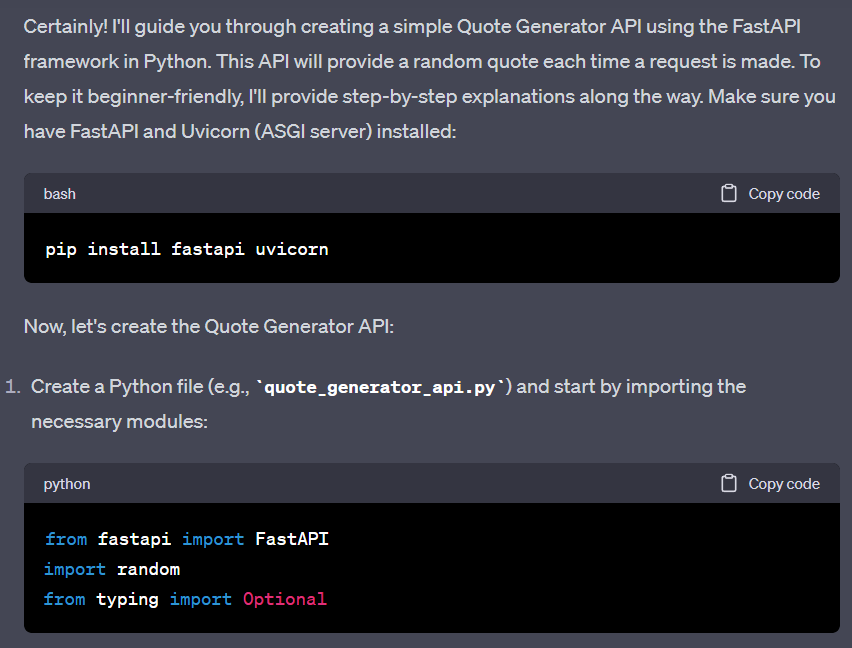
However, in this guide, Simply go to ChatGPT, craft a good prompt, and ENTER. Here’s a sample prompt you can use:
As an expert Python programmer with 20 years of experience.

Your task is to build an API with Python Fast API framework.

Style: Write the full code without skipping any part, and make sure to comment and explain every step, write for beginners!

API Idea: quote generator
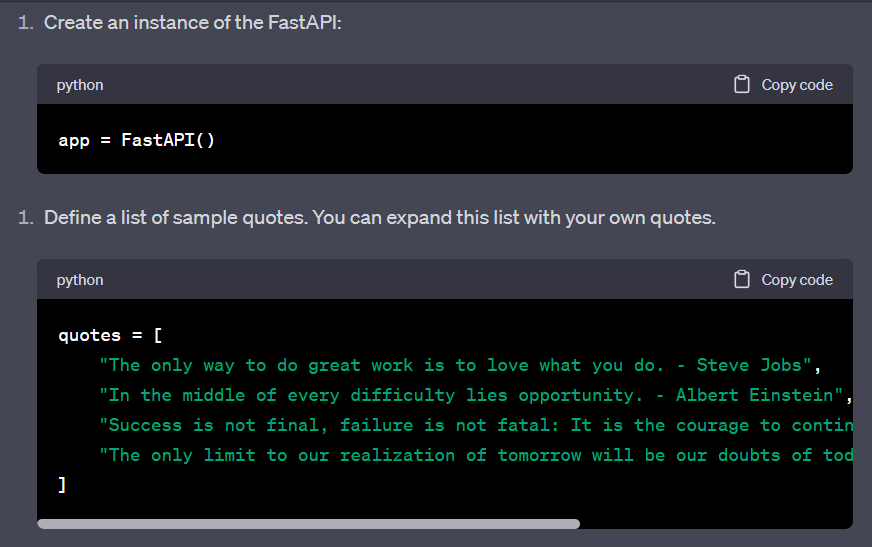
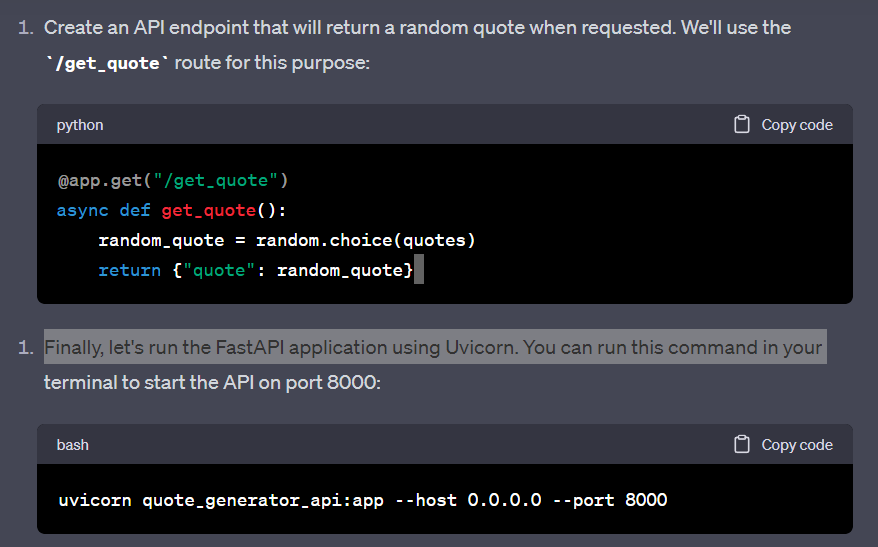
And here’s what ChatGPT would generate:
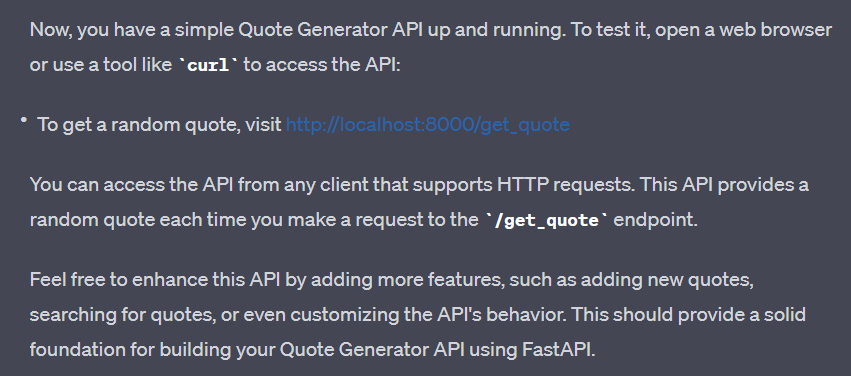
The API is all set and ready to use. However, you have to take into consideration that ChatGPT can’t do everything for you. There are many times that it generates a wrong output. So, you have to invest some time in learning how to code.
You may be asking yourself: “Why should I learn to code if I can just use no-code tools or hire someone to do that for me?”
Trust me on this one, AI can help you save a lot of money and time, so learn any coding Language and do that yourself.
Step 3: Host and Publish
In order for people to use your API it should be hosted online, and published on marketplaces for them to know about it.
You need to pick a service to host your API on, like Heroku, Digital Ocean, Kinsta, Contabo, or your own server. I already use Contabo for hosting services, so I used also it to host my APIs.
Then, you need to publish your API to marketplaces like RapidAPI. It’s very simple and straightforward to publish your API, just follow the steps and you’re good to go.
Plus, keep in mind you can always ask AI for help. Just enter your problem and it will help you seamlessly. For example, you can ask it to generate for you a full beginner step-by-step guide on how you can host your API on a [your hosting service].
Step 4: Promote Your API
Do some work and promote your APIs. Here are my top 3 methods to do so:
Method #1: Build Free / Paid tools
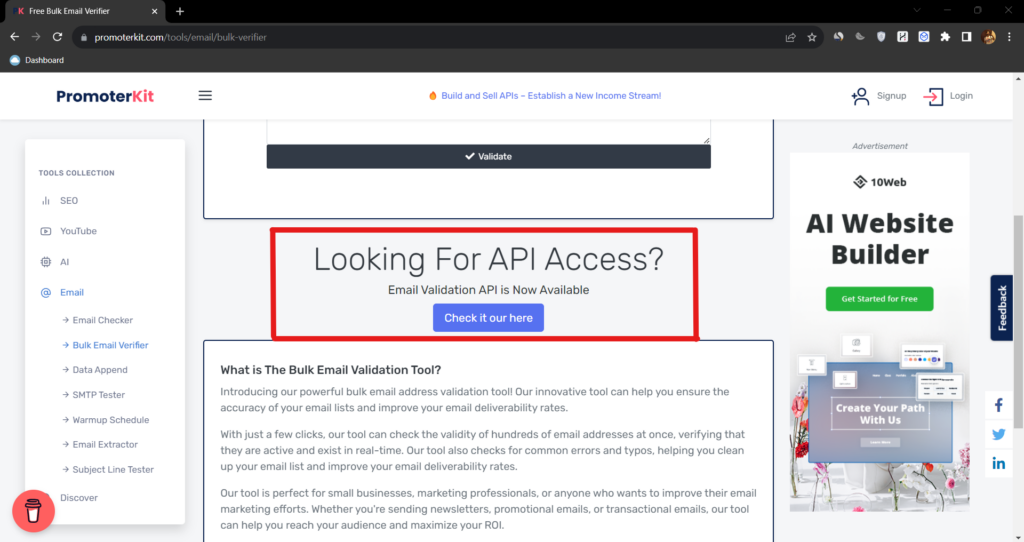
You can build tools using your API and promote the API in them. For example, on PromoterKit , there’s Email Validation Tool that is free to use, and I promote Email Validation API that you can use and access the API through your code.
So, I work on getting a lot of traffic to these free tools and then the API popularity will increase.
Method #2: Indirect Promotion with Guides
You build a step-by-step guide (can be a blog post) to do something using your API and you promote the API inside it.
So, you can promote APIs indirectly in a guide.
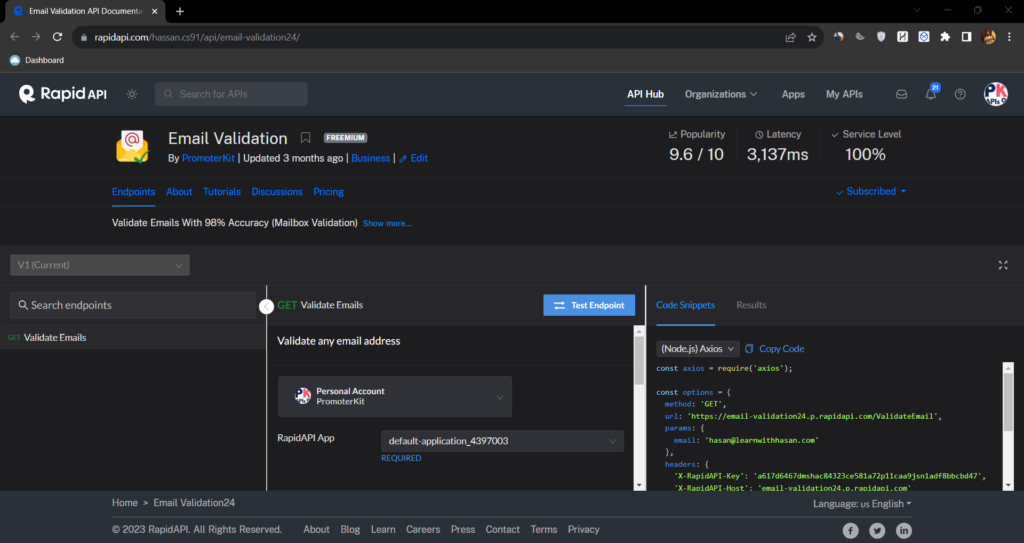
So, when people are following your guide and doing the steps they’re gonna have to use an API, and they would buy your API to do so!
Method #3: Publishing Open-Source Projects
If you dont know what open-source projects are. They provide free access to the source code, allowing anyone to use, modify, and share the software. This provides collaboration and innovation among a global community of contributors.
So, if you are a developer you can build your own open-source project, upload it to GitHub, and promote your API in it. So, in order for people to use your project they’re gonna have to access the API too.
There are a ton of other methods to promote your API like paid ads, outreach, libraries, content creation, etc… But, these are the top strategies that I use to promote my APIs.
Final Step: Rinse and Repeat
You can repeat this method multiple times, build a ton of APIs and have multiple monthly recurring income streams just from APIs!
Q&A: Your Key Questions Answered
Building and selling APIs with AI can be exciting, but it also raises several questions. Here’s a section tackling some of the most common:
Q: What are the technical skills required to build APIs with AI?
A: You’ll need a well-rounded skillset covering:
- Programming languages: Python is popular for API development, but familiarity with Java, JavaScript, or PHP can also be valuable.
- Web development frameworks: Frameworks like Flask, Django, or Node.js make API development smoother.
- AI libraries and frameworks: TensorFlow, PyTorch, or scikit-learn are essential for integrating AI functionality.
- Cloud computing platforms: Google Cloud Endpoints, Amazon API Gateway, or Azure API Management facilitate deployment and scaling.
Q: How much investment is needed to get started?
A: The initial investment varies depending on your chosen tools and platforms. You can begin with free options like open-source libraries and self-hosting, but paid cloud services offer advanced features and scalability. Consider starting small and scaling up as your API grows.
Q: What kind of AI features can I integrate into my API?
A: The possibilities are vast! Here are some examples:
- Machine learning models: Predict user behavior, analyze data, personalize recommendations.
- Natural language processing: Chatbots, sentiment analysis, content summarization, translation.
- Image and video processing: Object recognition, visual search, automatic content moderation.
Q: How can I ensure my API is secure and reliable?
A: Cybersecurity is paramount. Implement strong authentication and authorization measures, use encryption for sensitive data, and conduct regular security audits. Additionally, prioritize reliability by designing for scalability and redundancy.
Q: Where can I market and sell my API?
A: Popular marketplaces like RapidAPI, API Marketplace, and Postman Public APIs offer great reach and discovery. You can also build your own website and market to specific developer communities. Additionally, consider partnerships with complementary businesses to expand your audience.
Q: How can I build a sustainable API business?
Focus on three key pillars:
- Customer support: Be responsive and helpful to developers to ensure a positive experience.
- Continuous improvement: Gather feedback, iterate on features, and stay ahead of technological advancements.
- Community building: Engage with developers, promote your API, and foster a loyal user base.
Remember, success in the API market requires dedication, learning, and adaptation. This guide provides a valuable roadmap, but continuous research and exploration are key to building a thriving AI-powered API business.
By addressing these questions and delving deeper into each aspect, you can confidently embark on your journey to build and sell lucrative APIs with AI.
