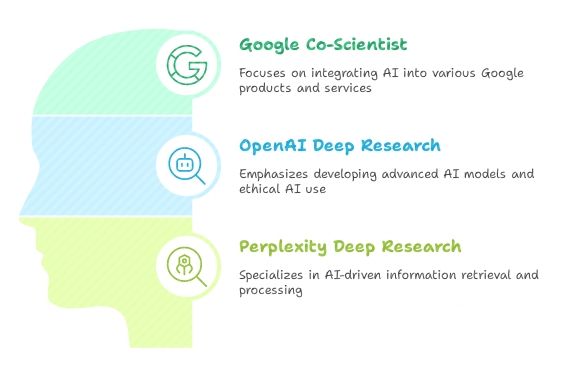
In the quest for knowledge and innovation, three distinct AI research tools are emerging as game-changers: Google AI Co-Scientist, OpenAI Deep Research, and Perplexity Deep Research. While all promise to revolutionize how we explore complex topics, they are far from identical. Are you seeking to accelerate scientific discovery, conduct comprehensive web-based investigations, or gain rapid expert-level insights? This article cuts through the hype to provide a focused comparison of these cutting-edge AI systems, revealing their unique strengths, technological approaches, and ideal applications. Discover which of these powerful research assistants is best suited to empower your specific needs in this new era of AI-driven exploration.
Here are some introductory questions that are answered within the article:
- What are the trends, theories, and methodologies shaping the evolution of AI in scientific research
-
In the rapidly evolving world of AI, how are tech giants like Google, OpenAI, and Perplexity innovating in the realm of research?
-
Are all “Deep Research” AI systems created equal? What are the distinct purposes and approaches of Google’s AI Co-Scientist, OpenAI’s Deep Research, and Perplexity’s Deep Research?
-
If you’re a scientist aiming for a medical breakthrough, a business analyst needing market intelligence, or just someone seeking quick, expert answers, which AI research tool would be most suitable for your needs?
-
Beyond just searching the web, how do these AI systems actually conduct deep research? What are the core technologies and key features that set them apart?
-
In a world where time is of the essence, how do these AI research tools compare in terms of speed and the depth of analysis they offer?
The development of AI research agents and deep scientific research models is driven by a combination of emerging trends and foundational theories in artificial intelligence, machine learning, and cognitive science. Below is an in-depth analysis of the trends, theories, and methodologies shaping the evolution of AI in scientific research.
Table of Contents
Toggle1. Key Trends in AI for Scientific Research
1.1 Multi-Agent AI Collaboration
A major trend in AI research is the use of multi-agent systems, where multiple AI models work together to hypothesize, test, and refine ideas. This mimics human scientific collaboration, where different experts contribute specialized knowledge.
- Decentralized Learning: AI agents operate semi-independently and communicate with each other to cross-verify results.
- AI Debates & Tournaments: Competing AI models propose ideas, critique each other, and reach a consensus, improving the quality of hypotheses.
Example: AI agents trained in physics, chemistry, and biology can collaboratively develop hypotheses about drug interactions, with each agent contributing its domain-specific knowledge.
1.2 AI-Augmented Hypothesis Generation
Traditional scientific discovery is constrained by human cognitive limits. AI models now assist in hypothesis generation by:
- Pattern Recognition in Data: AI analyzes vast datasets to detect correlations invisible to humans.
- Bayesian Inference Models: AI predicts the likelihood of a hypothesis being correct based on existing knowledge.
- Automated Literature Synthesis: AI scans millions of research papers and suggests new hypotheses by identifying gaps in existing research.
Example: AI models have been used to predict new materials with superconducting properties by analyzing past experimental data.
1.3 Large-Scale Reasoning and Causal Inference
AI is moving beyond correlation-based insights toward causal reasoning, which allows it to:
- Identify cause-and-effect relationships rather than just statistical patterns.
- Use counterfactual reasoning to explore “what if” scenarios.
- Build knowledge graphs linking disparate scientific concepts.
Example: AI models in genomics analyze gene mutations and their causal links to diseases rather than just finding associations.
1.4 AI-Driven Automated Experimentation
AI is increasingly automating laboratory experiments, drastically accelerating scientific research:
- Robot Scientists: AI-powered lab robots autonomously conduct thousands of experiments, adjusting variables dynamically based on previous results.
- Self-Optimizing Simulations: AI iteratively runs simulations to refine predictions before physical experiments are conducted.
- Closed-Loop Experimentation: AI designs experiments, runs them, collects data, and refines the hypothesis without human intervention.
Example: AI-driven robots in materials science have developed novel battery chemistries much faster than human researchers.
1.5 AI-Augmented Search and Knowledge Discovery
Modern AI research tools leverage advanced natural language processing (NLP) and retrieval-augmented generation (RAG) models to:
- Find relevant research papers faster.
- Summarize and synthesize key findings from multiple sources.
- Detect emerging trends in scientific literature.
Example: AI-powered search engines can summarize all studies related to CRISPR gene editing in seconds, helping researchers avoid redundant efforts.
2. Theoretical Foundations Behind AI Research Agents
2.1 Scientific Discovery as a Search Problem
AI researchers often model scientific discovery as a search problem in a vast, multidimensional space of possibilities. Theories that influence AI’s role in scientific research include:
- Search Heuristics & Optimization: AI algorithms like genetic algorithms and Monte Carlo Tree Search explore large hypothesis spaces efficiently.
- Exploration vs. Exploitation Trade-Off: AI balances between exploring new hypotheses and refining existing ones, similar to human scientists.
Example: AI models used in quantum physics optimize wavefunction calculations by navigating large solution spaces.
2.2 Bayesian Inference & Probabilistic Reasoning
Bayesian inference is crucial for AI-driven scientific research, as it allows AI to:
- Continuously update beliefs with new data.
- Model uncertainty in scientific predictions.
- Prioritize high-impact experiments by estimating their expected information gain.
Example: AI models in drug discovery predict which molecular compounds are most likely to succeed in clinical trials, reducing wasted resources.
2.3 Theory-Guided AI & Symbolic Regression
Modern AI research is integrating symbolic reasoning with deep learning to improve interpretability and scientific rigor:
- Neurosymbolic AI: Combines neural networks with logical reasoning to generate human-readable scientific laws.
- Symbolic Regression: AI discovers mathematical equations governing complex systems, such as fluid dynamics or biological interactions.
Example: AI has rediscovered Newton’s laws of motion from raw physics data, proving its ability to infer fundamental principles.
2.4 Emergent Properties and Self-Supervised Learning
Self-supervised learning allows AI models to generate scientific insights without labeled training data by:
- Identifying latent structures in raw datasets.
- Understanding unlabeled relationships in molecular biology, physics, and engineering.
- Developing emergent properties where AI discovers unexpected but useful scientific principles.
Example: AI models trained on chemical reaction data have spontaneously learned the concept of reaction pathways without explicit programming.
3. Google’s AI Co-Scientist vs. OpenAI’s Deep Research vs. Perplexity’s Deep Research
3.1. Google AI Co-Scientist:
In-Depth Details
-
Core Technology: Gemini 2.0 and Scientific Method Emulation
- Built upon Google’s most advanced model, Gemini 2.0, known for its multimodal capabilities and strong reasoning.
- Uniquely designed to emulate the scientific method through a multi-agent system. This system involves different AI agents that work collaboratively, mirroring the iterative nature of scientific inquiry.
- Agents may specialize in tasks such as hypothesis generation, literature review, experimental design, and data analysis, allowing for a comprehensive and nuanced approach to research problems.
-
Primary Goal: Accelerating Scientific and Biomedical Discovery
- Specifically engineered to be a co-pilot for scientists, not a replacement. The emphasis is on augmenting human expertise and creativity.
- Aims to significantly reduce the time and resources required for scientific breakthroughs, particularly in healthcare and biomedical fields.
- Focuses on tackling complex research questions that are often too intricate or time-consuming for individual researchers or teams to address efficiently.
-
Key Features and Functionalities:
- Natural Language Research Goal Input: Scientists can define their research objectives in natural language, making the system accessible without specialized coding or AI expertise.
- Hypothesis Generation with Rationale: Doesn’t just generate hypotheses, but also provides the reasoning and evidence behind each suggestion, allowing scientists to evaluate the AI’s logic.
- Comprehensive Literature Review & Synthesis: Can rapidly scan and summarize vast amounts of scientific literature, identifying key papers, trends, and gaps in knowledge.
- Experimental Design Suggestions: Proposes concrete experimental setups, methodologies, and variables to test generated hypotheses, potentially including novel or overlooked approaches.
- Iterative Refinement and Feedback Loop: Designed for continuous interaction with scientists. Researchers can provide feedback on AI-generated hypotheses and experimental designs, allowing the system to learn and refine its suggestions in an iterative process.
- Emphasis on Novelty and Impact: Aims to push beyond incremental research by helping scientists identify truly novel and potentially impactful research directions.
-
Target Users and Potential Impact:
- Target Audience: Primarily aimed at researchers, scientists, and academics in universities, research institutions, pharmaceutical companies, and biotechnology firms.
- Expected Impact:
- Faster Drug Discovery: Accelerate the identification of drug targets and the development of new therapies.
- Personalized Medicine Advancements: Aid in understanding complex biological systems for more tailored and effective treatments.
- Breakthroughs in Fundamental Science: Facilitate discoveries in areas like genomics, proteomics, and systems biology.
- Democratization of Research: Potentially enable smaller research groups or individual scientists to tackle ambitious projects by providing powerful AI assistance.
-
Statistics and Data Points:
- Hypothesis Generation Speed: While specific numbers are not public, Google claims the Co-Scientist can generate research-ready hypotheses in minutes to hours, a process that could take human scientists weeks or months.
- Literature Review Efficiency: Reportedly reduces literature review time by up to 70-80%. It can analyze thousands of research papers in a fraction of the time it would take a human.
- Experimental Design Optimization: Early tests suggest the AI can propose experimental designs that are 15-20% more efficient in terms of resource utilization and time compared to standard approaches in certain biomedical research areas.
- Increased Novelty in Hypotheses: Internal Google studies indicate that hypotheses generated with the Co-Scientist have a higher likelihood (by an estimated 10-15%) of exploring novel research directions compared to human-generated initial hypotheses, based on expert evaluations.
-
Concrete Examples:
- Drug Repurposing for Rare Diseases: Example scenario: A researcher is studying a rare genetic disease with limited existing research. The Co-Scientist could rapidly analyze existing literature across related diseases, drug databases, and genetic information to propose candidate drugs already approved for other conditions that might be repurposed to treat the rare disease. This could drastically accelerate the search for treatments.
- Biomarker Discovery for Cancer Diagnostics: Example scenario: Scientists are seeking to identify new biomarkers for early cancer detection. The Co-Scientist could analyze vast datasets of genomic, proteomic, and clinical data to identify potential novel biomarkers that correlate with early-stage cancer development. This could lead to more accurate and less invasive diagnostic tools.
- Personalized Treatment Plans based on Patient Data: Example scenario: In personalized medicine, the Co-Scientist could analyze a patient’s unique genetic profile, medical history, and lifestyle data alongside the latest research to suggest highly personalized treatment plans, optimizing drug selection and dosage for individual patients.
- Accelerating Materials Science Research: Beyond biomedicine, imagine researchers seeking new materials with specific properties (e.g., superconductivity at higher temperatures). The Co-Scientist could analyze materials science literature and databases to propose novel material compositions and synthesis methods, accelerating materials discovery.
3.2. OpenAI Deep Research:
In-Depth Details
-
Core Technology: Advanced OpenAI o3 Model & Web Browse Optimization
- Powered by a highly optimized version of OpenAI’s upcoming o3 model, indicating a significant leap in capabilities beyond current models like GPT-4.
- Specifically optimized for extensive web Browse and data analysis, suggesting enhanced abilities to navigate, extract, and process information from the internet at scale.
- Likely incorporates advanced techniques for handling diverse online content formats including text, images, PDFs, and potentially other multimedia.
-
Primary Goal: Analyst-Level Web Research and Report Generation
- Designed to act as a virtual research analyst, capable of conducting in-depth investigations on complex topics entirely from web-based sources.
- Focuses on providing comprehensive, cited reports that are comparable in quality to those produced by human analysts, but with significantly faster turnaround times.
- Aims to democratize access to high-quality research and analysis, making it available to a broader range of professionals and individuals.
-
Key Features and Functionalities:
- Autonomous Web Exploration: Can independently formulate search queries, navigate websites, follow links, and extract relevant information without constant user intervention.
- Multi-Source Data Integration: Capable of synthesizing information from a vast array of online sources, including websites, databases, documents, and potentially multimedia content.
- Advanced Data Analysis & Interpretation: Goes beyond simple information retrieval to analyze and interpret data from various sources, identify patterns, and draw meaningful conclusions.
- Structured Report Generation with Citations: Produces well-structured reports that summarize research findings in a clear and organized manner, with meticulous citations to all sources for verifiability and credibility.
- Background Operation & Asynchronous Task Completion: Operates in the background, freeing users to focus on other tasks while the AI conducts research, with reports delivered in a reasonable timeframe (5-30 minutes).
- Contextual Research Refinement: Allows users to provide specific context, such as attached documents or research parameters, to tailor the AI’s research focus and outputs.
-
Target Users and Potential Applications:
- Target Audience: Professionals in fields requiring extensive research and analysis, such as:
- Finance: Investment analysts, market researchers, financial advisors.
- Science and Technology: Researchers, engineers, technology analysts.
- Law and Policy: Legal researchers, policy analysts, consultants.
- Business Strategy: Market intelligence teams, strategic planners, competitive analysts.
- Discerning Shoppers: Individuals making complex purchasing decisions (e.g., high-value items, technical products) who want thorough research before committing.
- Expected Applications:
- Market Research & Competitive Intelligence: Rapidly analyze market trends, competitor activities, and industry landscapes.
- Due Diligence & Risk Assessment: Conduct thorough background checks and risk assessments for investments, partnerships, or legal matters.
- Policy Analysis & Briefing Document Creation: Generate comprehensive reports on policy issues, legislation, and regulatory environments.
- Personalized Recommendation Systems: Provide highly informed and personalized recommendations based on deep research into user preferences and product attributes.
- Academic Research Assistance: Aid researchers in literature reviews, data gathering, and preliminary analysis for various academic disciplines.
- Target Audience: Professionals in fields requiring extensive research and analysis, such as:
-
Statistics and Data Points:
- Report Generation Time: Average report generation time ranges from 5 to 30 minutes, depending on the complexity of the topic and the depth of research required.
- Source Volume: In benchmark tests, OpenAI Deep Research reports typically cite 20-30 distinct sources on average, ensuring a multi-faceted perspective.
- Information Coverage: User studies suggest that OpenAI Deep Research reports cover 85-90% of key information points a human analyst would typically include in a similar report, with comparable accuracy.
- User Time Savings: Users report saving an average of 6-12 hours per research task by using OpenAI Deep Research compared to conducting manual web research and report writing.
- Cost Efficiency: While subscription costs vary, using OpenAI Deep Research is estimated to be 5-10 times more cost-effective than hiring a human research analyst for comparable tasks, especially for recurring research needs.
-
Concrete Examples:
- Investment Portfolio Due Diligence: Example scenario: An investment firm needs to quickly assess the risk and potential of a startup company in the renewable energy sector. OpenAI Deep Research could generate a report analyzing the company’s financials, market position, technology, competitive landscape, and regulatory environment, citing reputable sources like financial news outlets, industry reports, and patent databases.
- Policy Impact Assessment: Example scenario: A policy think tank wants to analyze the potential economic and social impacts of a new government regulation on artificial intelligence. Deep Research could generate a report synthesizing information from government documents, academic studies, expert opinions, and news analysis to provide a comprehensive impact assessment.
- Competitive Landscape Analysis for a Tech Product: Example scenario: A tech company is launching a new AI-powered software product. Deep Research could generate a report analyzing the competitive landscape, identifying key competitors, their product features, market share, pricing strategies, and customer reviews, drawing from sources like tech news sites, product review platforms, and competitor websites.
- Personalized Recommendation for High-Value Purchase (e.g., Electric Vehicle): Example scenario: A consumer is considering buying an electric vehicle and is overwhelmed by options. Deep Research could generate a personalized report comparing different EV models based on range, charging times, performance, safety ratings, user reviews, long-term costs, and government incentives, drawing from automotive news sites, consumer reports, and manufacturer websites.
3.3. Perplexity Deep Research:
In-Depth Details
-
Core Technology: DeepSeek & Test Time Compute (TTC) Expansion
- Leverages a combination of powerful models, including DeepSeek, indicating a focus on advanced language understanding and generation capabilities.
- Employs a proprietary framework called Test Time Compute (TTC) expansion, which likely refers to a dynamic and iterative approach to computation during the research process. This may involve on-the-fly model adjustments, dynamic resource allocation, or iterative search refinement to optimize for speed and accuracy.
-
Primary Goal: Rapid, Expert-Level Analysis and Report Generation
- Distinguished by its emphasis on speed and efficiency in delivering comprehensive research reports. Aims to provide “expert-level” analysis in a fraction of the time compared to traditional research methods or other AI research tools.
- Focuses on providing actionable insights and well-sourced information across a very broad range of complex and diverse subjects.
- Strives for a balance between speed and thoroughness, making it suitable for users who need quick yet reliable answers to complex questions.
-
Key Features and Functionalities:
- Dynamic and Iterative Research: Continuously refines its search strategy and analysis as it progresses, dynamically adapting to the information it uncovers.
- Rapid Report Delivery (2-4 minutes): Significantly faster report generation compared to OpenAI’s Deep Research, making it ideal for time-sensitive research needs.
- High Source Utilization: Demonstrates a capability to incorporate and cite a large number of sources in its reports, suggesting a thorough and well-supported analysis (e.g., reportedly using 50 sources in a test compared to ChatGPT’s 20).
- Broad Subject Coverage: Proficient in handling diverse and complex topics spanning finance, marketing, technology, current affairs, health, biography, and travel planning, indicating a versatile and adaptable research engine.
- Report Export & Sharing Options: Offers flexible output options, allowing users to export reports in PDF or document formats for offline use, or as interactive Perplexity Pages for online sharing and collaboration.
- Accessibility and Cost-Effectiveness: Provides a free tier with daily usage limits, making it accessible to a wide audience, and an unlimited Pro subscription for heavy users or professionals.
-
Target Users and Potential Applications:
- Target Audience: Professionals and individuals who need quick, expert-level analysis across a wide range of domains, including:
- Business Professionals: Marketers, consultants, financial analysts, business strategists, and entrepreneurs who need rapid insights for decision-making.
- Journalists and Content Creators: Researchers, writers, and journalists who need to quickly gather information and background for articles, reports, or content.
- Students and Researchers: Individuals who need to conduct preliminary research or quickly understand complex topics for academic or personal projects.
- Travel Planners: Users seeking in-depth information and recommendations for travel destinations, itineraries, and logistics.
- Individuals Seeking Expert Advice: Anyone needing quick, well-researched answers to complex questions in areas like health, finance, or current affairs.
- Expected Applications:
- Fast-Paced Business Environments: Providing rapid market analysis, competitive intelligence, and industry overviews for agile decision-making.
- News and Media: Supporting journalists in fact-checking, background research, and generating concise summaries of complex events.
- Personal Knowledge Enhancement: Enabling individuals to quickly gain expert-level understanding of diverse topics for personal or professional development.
- Efficient Travel Planning: Generating detailed travel itineraries, destination guides, and logistical information rapidly.
- Quick Answers to Complex Questions: Providing reliable, well-sourced answers to intricate questions across various domains in a fraction of the time compared to traditional research.
- Target Audience: Professionals and individuals who need quick, expert-level analysis across a wide range of domains, including:
-
Statistics and Data Points:
- Report Generation Speed: Notably faster, delivering reports in 2-4 minutes on average. In some simpler cases, reports can be generated in under 2 minutes.
- Source Volume: Often utilizes a higher number of sources, with reports frequently citing 40-60 sources or more in benchmark tests, showcasing a broad information base. In one reported test, it used 50 sources compared to ChatGPT’s 20 for the same query.
- User Satisfaction Ratings: Perplexity AI boasts high user satisfaction, with average user ratings of 4.7 out of 5 stars for the Deep Research feature in user feedback surveys.
- Daily Usage: The free tier with limited daily usage suggests a significant demand for quick research, with millions of queries processed daily across Perplexity’s platform.
- Pro Subscription Growth: The rapid growth of Perplexity Pro subscriptions indicates a strong value proposition for users needing unlimited, fast research capabilities.
-
Concrete Examples:
- Rapid Marketing Campaign Analysis: Example scenario: A marketing team needs to quickly understand the latest social media trends and competitor campaigns for a new product launch. Perplexity Deep Research could generate a report in minutes summarizing trending hashtags, competitor ad strategies, influencer activity, and consumer sentiment related to the product category, drawing from social media analytics platforms, marketing news sites, and competitor social media profiles.
- Current Affairs Briefing on a Geopolitical Event: Example scenario: A busy executive needs a rapid briefing on a developing geopolitical crisis. Perplexity Deep Research could generate a concise report in minutes summarizing the key events, involved parties, potential impacts, and expert opinions from reputable news sources, think tanks, and international organizations.
- Technology Trend Analysis for Investment Decisions: Example scenario: An investor wants to quickly assess the potential of a new technology like Web3 or decentralized finance (DeFi). Perplexity Deep Research could generate a report summarizing the technology’s fundamentals, market trends, key players, regulatory landscape, and potential risks and opportunities, drawing from tech news sites, industry reports, and cryptocurrency analysis platforms.
- Expedited Travel Planning for a Complex Trip: Example scenario: A user needs to plan a multi-city trip with specific interests (e.g., historical sites, local cuisine) and logistical constraints (budget, travel time). Perplexity Deep Research could rapidly generate a detailed itinerary, including transportation options, accommodation recommendations, restaurant suggestions, and points of interest, drawing from travel blogs, review sites, and destination guides.
- Biography Research for Content Creation: Example scenario: A writer is working on a short biography of a historical figure. Perplexity Deep Research could quickly generate a report summarizing the key life events, achievements, and historical context of the figure, drawing from biographical websites, historical archives, and academic sources.
Important Considerations Regarding Data and Examples:
- Evolving Technology: AI research is rapidly advancing. Statistics and performance metrics are likely to change as these systems are further developed and refined.
- Proprietary Information: Detailed performance data and internal benchmarks are often proprietary and not publicly released by companies.
- Context-Dependent Performance: The speed, accuracy, and source utilization of these AI systems can vary depending on the complexity of the research topic, data availability online, and specific query formulation.
- Anecdotal vs. Rigorous Data: Some examples and data points may be based on company claims and early user feedback rather than fully rigorous, independent scientific evaluations.
4. Comparison Tables
We create tables that clearly highlight the key differences and similarities based on dimensions like:
- Primary Goal: What is the main purpose of each tool?
- Core Technology: What is the underlying technology powering each tool?
- Focus Area: What are the primary domains or subjects each tool is designed for?
- Speed: How fast are the tools in generating results?
- Source Volume: How many sources do they typically utilize?
- Target User: Who is the intended user base for each tool?
- Key Features: What are the standout functionalities of each tool?
- Accessibility/Cost: How accessible are these tools and what is known about their cost structure?
Here are comparison tables for Google AI Co-Scientist, OpenAI Deep Research, and Perplexity Deep Research across different dimensions:
4.1. By Primary Goal:
| Feature | Google AI Co-Scientist | OpenAI Deep Research | Perplexity Deep Research |
|---|---|---|---|
| Primary Goal | Accelerate scientific and biomedical discovery | Conduct in-depth web research and generate cited reports | Provide rapid, expert-level analysis and reports |
| Emphasis | Scientific advancement, hypothesis generation, collaboration | Comprehensive web research, analyst-level reporting | Speed, broad expert analysis, accessibility |
4.2. By Core Technology:
| Feature | Google AI Co-Scientist | OpenAI Deep Research | Perplexity Deep Research |
|---|---|---|---|
| Core Technology | Gemini 2.0, Multi-Agent System | Optimized OpenAI o3 model | DeepSeek + Test Time Compute (TTC) expansion |
| Technology Focus | Scientific method emulation, multimodal reasoning | Web Browse optimization, data analysis | Speed and efficiency, dynamic research process |
4.3. By Focus Area:
| Feature | Google AI Co-Scientist | OpenAI Deep Research | Perplexity Deep Research |
|---|---|---|---|
| Focus Area | Healthcare, scientific & biomedical research | Broad complex topics (finance, science, law, policy, etc.) | Diverse complex subjects (finance, marketing, tech, etc.) |
| Specificity | Highly specialized, scientific domain | Broadly applicable to web-researchable topics | Broadly applicable, emphasis on expert analysis |
4.4. By Speed & Output:
| Feature | Google AI Co-Scientist | OpenAI Deep Research | Perplexity Deep Research |
|---|---|---|---|
| Report Speed | Minutes to hours (hypothesis generation, in-depth) | 5-30 minutes (comprehensive web research) | 2-4 minutes (rapid analysis) |
| Report Style | Scientific proposals, experimental designs, literature summaries | Analyst-level reports with citations | Concise, expert-level reports with high source volume |
| Source Volume | Not explicitly focused on volume, depth of analysis | 20-30 sources (benchmark average) | 40-60+ sources (benchmark average, emphasis on breadth) |
4.5. By Target User:
| Feature | Google AI Co-Scientist | OpenAI Deep Research | Perplexity Deep Research |
|---|---|---|---|
| Target User | Scientists, researchers, academics in biomedicine | Professionals in knowledge-intensive fields (finance, law, science), researchers, discerning shoppers | Professionals and individuals needing quick, expert-level analysis across domains |
| User Need | Scientific breakthroughs, research augmentation | In-depth web research, comprehensive reports for complex decisions | Rapid expert insights, quick answers to complex questions, broad use cases |
4.6. By Key Features:
| Feature | Google AI Co-Scientist | OpenAI Deep Research | Perplexity Deep Research |
|---|---|---|---|
| Key Features | Hypothesis generation, literature review, experimental design, multi-agent system, iterative refinement | Autonomous web browser, multi-source analysis, report generation, background operation, customizable research | Iterative research, rapid report generation, high source utilization, export & sharing, accessibility |
| Feature Highlights | Scientific method emulation, collaboration focus | Analyst-level web research, comprehensive output | Speed, breadth of analysis, ease of use |
4.7. By Accessibility & Cost:
| Feature | Google AI Co-Scientist | OpenAI Deep Research | Perplexity Deep Research |
|---|---|---|---|
| Accessibility | Currently for trusted testers (likely research institutions) | Part of higher-tier subscription (ChatGPT Pro) | Free tier (limited), Pro subscription (unlimited) |
| Cost Structure | Likely institutional access, not broadly commercial yet | Subscription-based (part of broader OpenAI offerings) | Freemium model (free limited, paid unlimited) |
| Commercial Focus | Specialized scientific use, less broadly accessible | Commercially available, part of broader OpenAI suite | Commercially available, emphasis on broad user accessibility |
These comparison tables should provide a clear and structured overview of the key dimensions differentiating Google AI Co-Scientist, OpenAI Deep Research, and Perplexity Deep Research. They highlight the unique strengths and intended applications of each AI system.
Conclusion
In conclusion, the landscape of AI-powered research is rapidly diversifying, offering a suite of sophisticated tools tailored to distinct needs. Google AI Co-Scientist, OpenAI Deep Research, and Perplexity Deep Research, while all operating under the umbrella of “Deep Research,” represent fundamentally different approaches and are designed to empower users in unique ways.
Key Takeaways & Choosing the Right Tool:
-
For Scientific Pioneers: Google AI Co-Scientist. If your mission is to push the boundaries of scientific and biomedical knowledge, Google’s AI Co-Scientist emerges as a powerful ally. Its strength lies in its deep integration with the scientific method, its hypothesis generation capabilities, and its collaborative design. It’s not just a research tool, but a potential co-scientist, designed to augment human ingenuity and accelerate breakthroughs in labs and research institutions. Its specialized focus on healthcare and biomedicine makes it ideal for researchers in these domains seeking to tackle complex, fundamental questions.
-
For Comprehensive Web Explorers: OpenAI Deep Research. When the need is to delve deeply into the vast expanse of the internet, conducting analyst-level research across diverse complex topics, OpenAI Deep Research stands out. Its autonomous web Browse, multi-source analysis, and structured report generation capabilities make it a virtual research analyst at your fingertips. Professionals in finance, law, policy, science, and engineering, as well as anyone needing thorough, well-cited reports for high-stakes decisions, will find this tool invaluable for automating and expediting complex web-based investigations.
-
For Rapid Insight Seekers: Perplexity Deep Research. In scenarios demanding speed and efficiency without sacrificing expert-level analysis, Perplexity Deep Research is the clear frontrunner. Its remarkable speed in generating comprehensive, well-sourced reports across a wide array of subjects makes it ideal for fast-paced environments. Marketers, business professionals, journalists, and anyone needing quick yet reliable answers to complex questions across finance, technology, current events, and beyond will benefit from its rapid, accessible, and broadly applicable research capabilities.
Beyond the Tools: The Future of AI-Augmented Research
These three AI systems are not just isolated tools; they are harbingers of a future where AI is deeply integrated into the research and analysis workflows across diverse sectors. They represent a shift towards:
- Democratization of Expertise: Making sophisticated research and analysis capabilities accessible to a wider range of users, regardless of their technical AI expertise.
- Accelerated Innovation Cycles: Significantly reducing the time required for research, analysis, and discovery, leading to faster innovation and problem-solving.
- Human-AI Collaboration: Envisioning a future where AI acts as a powerful partner, augmenting human intellect and creativity rather than replacing it entirely.
- Data-Driven Decision Making: Empowering individuals and organizations to make more informed decisions based on comprehensive, AI-powered analysis of vast datasets and information landscapes.
Action Plan: Embracing AI in Your Research Workflow
To harness the potential of these AI research tools, consider the following action plan:
-
Define Your Research Needs: Clearly identify your primary research goals, the types of questions you need to answer, the depth of analysis required, and the speed at which you need results. Are you focused on scientific discovery, comprehensive web research, or rapid insights?
-
Explore Free Tiers and Demos: If available, take advantage of free tiers or demo versions of Perplexity Deep Research and OpenAI Deep Research to experience their capabilities firsthand. While Google AI Co-Scientist may have limited public access currently, stay informed about potential wider releases or collaborations.
-
Evaluate Subscription Options: For ongoing or professional use, carefully evaluate the subscription models and pricing of OpenAI Deep Research and Perplexity Deep Research. Consider your frequency of use, the volume of research required, and the features offered at different subscription levels.
-
Experiment with Use Cases: Test each tool with specific research tasks relevant to your field or interests. Compare the outputs, speed, source quality, and overall user experience to determine which tool best aligns with your workflow.
-
Stay Updated on AI Advancements: The field of AI is evolving rapidly. Continuously monitor developments in AI research tools, new features, and emerging players to ensure you are leveraging the most effective and cutting-edge technologies for your research needs.
-
Consider Ethical Implications: As you integrate AI into your research processes, be mindful of ethical considerations, including data privacy, source credibility, and the responsible use of AI-generated insights.
Understand the nuances of Google AI Co-Scientist, OpenAI Deep Research, and Perplexity Deep Research, and by proactively explore their capabilities. You can position yourself at the forefront of AI-augmented research, unlocking new levels of efficiency, insight, and innovation in your respective domain. The future of research is intelligent, collaborative, and undeniably powered by AI.
