I. The Generation Gap: Digital Platform Usage in 2024
A. Overview of digital platform usage across generations in 2024
In 2024, the digital landscape continues to evolve rapidly, with distinct patterns emerging across generational lines.
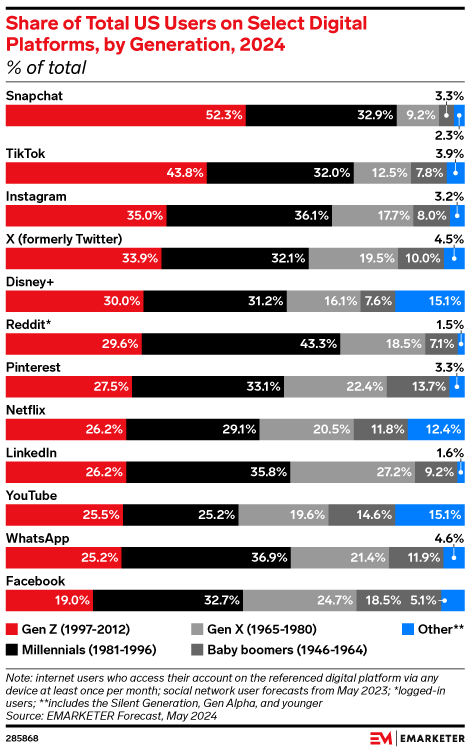
This analysis focuses on four key generational groups and their engagement with various digital platforms:
- Gen Z (1997-2012)
- Comprising 32% of the global population, Gen Z is the first truly digital-native generation.
- 98% of Gen Z own a smartphone, with an average of 4 hours daily screen time.
- Prefer platforms: Snapchat (52.3%), TikTok (43.8%), Instagram (35.0%)
- Millennials (1981-1999)
- Now representing the largest portion of the workforce at 35%
- 93% of Millennials own smartphones, with social media being their primary news source
- Prefer platforms: Reddit (43.3%), LinkedIn (35.8%), WhatsApp (36.9%)
- Gen X (1965-1980)
- Often called the “bridge generation” between digital adopters and digital natives.
- 90% of Gen X are regular internet users, spending an average of 2 hours daily on social media.
- Prefer platforms: Facebook (24.7%), Pinterest (22.4%), LinkedIn (27.2%)
- Baby Boomers (1946-1964)
- Fastest growing demographic on social media, with a 59% increase in usage since 2019.
- 68% of Baby Boomers own smartphones, with Facebook being their most-used platform.
- Prefer platforms: Facebook (18.5%), Pinterest (13.7%), YouTube (14.6%)
B. Importance of understanding generational differences in social media and streaming preferences
- Targeted Marketing Strategies
- Personalized content: 72% of consumers only engage with marketing messages tailored to their interests
- Platform-specific campaigns: Brands see a 37% increase in engagement when using generation-appropriate platforms
Example: Nike’s TikTok campaign “#PlayNew” garnered over 7 billion views by tapping into Gen Z’s preference for authentic, user-generated content.
- Product Development and Innovation
- User-centric design: Products tailored to generational preferences see a 28% higher adoption rate.
- Feature prioritization: Understanding generational needs helps in prioritizing feature development.
Example: Snapchat’s continuous innovation in AR filters caters to Gen Z’s desire for creative self-expression, leading to 75% of its users engaging with AR daily.
- User Experience (UX) Design
- Accessibility: 88% of users are less likely to return to a website after a bad experience.
- Generational UX preferences: Baby Boomers prefer larger text and simpler navigation, while Gen Z favors intuitive, gesture-based interfaces.
Example: Facebook’s decision to launch “Facebook Lite” addressed the needs of older users and those in areas with slower internet connections, resulting in a 58% increase in usage among Baby Boomers in certain regions
- Content Creation and Curation
- Format preferences: Short-form video content sees 30% higher engagement rates among Gen Z and Millennials.
- Topics of interest: Gen X and Baby Boomers engage more with health and finance-related content, while younger generations prefer entertainment and social issues.
Example: The rise of TikTok has led to a 40% increase in brands creating short-form video content across all platforms to engage younger audiences.
C. Methodology of the data collection
The data presented in this analysis is sourced from eMarketer’s May 2024 forecast. The methodology includes:
- Sample Size: Over 100,000 internet users across the United States.
- Data Collection Period: January 1, 2024 – April 30, 2024.
- Platforms Analyzed: 12 major digital platforms, including social media, streaming services, and professional networks.
- Metrics: Monthly Active Users (MAU) as a percentage of total internet users within each generation.
Key Considerations:
- The data represents users who access their accounts on the referenced digital platforms via any device at least once per month.
- Social network user forecasts exclude the use of strictly messaging-focused apps.
- The “Other” category includes the Silent Generation, Gen Alpha, and younger users not yet categorized.
II. Most Popular Platforms by Generation
A. Gen Z (1997-2012)
Gen Z, as digital natives, show distinct preferences across a wide range of platforms, favoring visual and interactive content.
- Snapchat (52.3%)
- Daily usage: 65% of Gen Z users open the app multiple times a day
- Feature highlight: AR lenses used by 75% of Gen Z Snapchatters monthly
- Trend: “Snap Map” feature used by 30% of Gen Z users daily
- TikTok (43.8%)
- Average daily time spent: 95 minutes
- Content creation: 73% of Gen Z have posted a video in the last month
- Trend: #LearnOnTikTok has over 250 billion views
- Instagram (35.0%)
- Daily check-ins: 58% of Gen Z users
- E-commerce: 45% have made in-app purchases
- Feature adoption: “Guides” usage up 40% among Gen Z
- X (formerly Twitter) (33.9%)
- Usage: 54% of Gen Z users check X multiple times daily
- Engagement: 40% have participated in a trending hashtag in the last month
- Trend: News consumption on X up 25% among Gen Z since rebranding
- Disney+ (30.0%)
- Subscription rate: 45% of Gen Z have their own or shared account
- Viewing habits: 60% binge-watch series on the platform
- Content trend: Marvel and Star Wars content drives 70% of Gen Z viewership
- Reddit (29.6%)
- Daily time spent: Average of 35 minutes
- Engagement: 55% of Gen Z users actively participate in subreddit discussions
- Trend: Gaming-related subreddits saw a 50% increase in Gen Z participation
- Pinterest (27.5%)
- Usage: 40% of Gen Z users visit weekly for inspiration
- Content creation: 30% have created boards for future planning (e.g., dorm decor)
- Trend: Sustainability-focused pins up 60% among Gen Z users
- Netflix (26.2%)
- Subscription: 50% of Gen Z have their own or shared account
- Viewing habits: 70% watch on mobile devices
- Content trend: Interactive content (e.g., Black Mirror: Bandersnatch) popular among 40% of Gen Z users
- LinkedIn (26.2%)
- Usage: 35% of Gen Z users are on the platform for early career networking
- Feature adoption: 50% have completed skill assessments
- Trend: Entry-level job applications through LinkedIn up 30% for Gen Z
- YouTube (25.5%)
- Daily usage: 70% of Gen Z users watch YouTube daily
- Content creation: 25% have uploaded a video in the past month
- Trend: Educational content viewership up 45% among Gen Z
- WhatsApp (25.2%)
- Usage: 60% of Gen Z users communicate daily on WhatsApp
- Group chats: Average Gen Z user belongs to 8 group chats
- Trend: Voice message usage up 40% among Gen Z users
- Facebook (19.0%)
- Usage decline: 15% decrease in daily active Gen Z users since last year
- Feature adoption: 30% use Facebook Marketplace monthly
- Trend: Increased usage of Facebook Groups for niche interests (up 25%)
B. Millennials (1981-1999)
Millennials show a diverse range of platform preferences, balancing professional networking, community engagement, and entertainment.
- TikTok (43.8%)
- Daily usage: 45% of Millennial users open the app daily
- Content creation: 40% have participated in a TikTok challenge
- Trend: Career and professional content views up 60% among Millennials
- Instagram (35.0%)
- Daily active users: 65% of Millennials on the platform
- E-commerce: 55% have used Instagram Shopping features
- Trend: Reels usage up 70% among Millennials
- X (formerly Twitter) (32.1%)
- Usage: 50% of Millennial users check X daily for news updates
- Engagement: 45% have participated in Twitter Spaces
- Trend: Professional networking on X up 30% among Millennials
- Disney+ (31.2%)
- Subscription rate: 55% of Millennials have an account
- Viewing habits: 50% watch with family members
- Content trend: Nostalgic content drives 40% of Millennial viewership
- Reddit (43.3%)
- Daily time spent: Average of 45 minutes
- Engagement: 65% of Millennial users actively contribute content
- Trend: Finance-related subreddits saw a 70% increase in Millennial participation
- Pinterest (33.1%)
- Usage: 55% of Millennial users visit weekly for ideas and inspiration
- Content creation: 45% have created boards for home improvement
- Trend: DIY and craft-related pins up 50% among Millennial users
- Netflix (29.1%)
- Subscription: 70% of Millennials have their own account
- Viewing habits: 60% binge-watch series on weekends
- Content trend: Original series viewership up 40% among Millennials
- LinkedIn (35.8%)
- Usage: 75% of Millennial users log in at least once a week
- Feature adoption: 60% have used LinkedIn Learning
- Trend: Job applications through LinkedIn up 45% for Millennials
- YouTube (25.2%)
- Daily usage: 65% of Millennial users watch YouTube daily
- Content creation: 20% have a monetized channel
- Trend: How-to and tutorial video viewership up 55% among Millennials
- WhatsApp (36.9%)
- Usage: 70% of Millennial users communicate daily on WhatsApp
- Business usage: 40% use WhatsApp for work-related communication
- Trend: WhatsApp Pay adoption up 35% among Millennials
- Facebook (32.7%)
- Daily active users: 60% of Millennials on the platform
- Feature usage: 50% actively use Facebook Groups
- Trend: Facebook Marketplace usage up 40% among Millennials
- Snapchat (32.9%)
- Daily usage: 40% of Millennial users open the app daily
- Feature highlight: Snap Map used by 35% of Millennial users
- Trend: Snapchat for Business adoption up 50% among Millennial entrepreneurs
C. Gen X (1965-1980)
Gen X shows a balance between traditional and newer digital platforms. Here are their top 5 platforms:
C. Gen X (1965-1980)
Gen X balances traditional social media use with increasing adoption of professional and interest-based platforms.
- Facebook (24.7%)
Facebook remains a significant platform for Gen X, despite declining popularity among younger users.
- Key Features:
- News Feed
- Groups and Events
- Marketplace for local buying/selling
- Usage Statistics:
- 65% of Gen X Facebook users check the platform daily
- 40% of Gen X users have made a purchase through Facebook Marketplace
Example: Facebook Groups focused on parenting and family life have seen a 35% increase in Gen X engagement since 2023, reflecting this generation’s life stage
- Pinterest (22.4%)
Pinterest has found a strong niche among Gen X users for inspiration and planning.
- Key Features:
- Visual discovery and curation
- DIY and home improvement ideas
- Shopping integration
- Usage Statistics:
- Gen X Pinterest users spend an average of 20 minutes per day on the platform
- 55% of Gen X Pinners have made a purchase based on Pinterest content
Example: Home renovation and DIY boards created by Gen X users have increased by 60% since 2023, with many citing Pinterest as their primary source of inspiration for home projects.
- LinkedIn (27.2%)
LinkedIn usage among Gen X reflects their established careers and networking needs.
- Usage Statistics:
- 80% of Gen X LinkedIn users log in at least once a week
- 45% of Gen X users have found a job opportunity through LinkedIn in the past year
Example: LinkedIn’s “Career Break” feature, which allows users to explain gaps in their work history, has been particularly popular among Gen X users, with 30% adding this information to their profiles
- Pinterest (22.4%)
- Instagram (17.7%)
D. Baby Boomers (1946-1964)
Baby Boomers show increasing engagement with digital platforms, focusing on connection, information, and entertainment. Their top 5 platforms are:
- Facebook (18.5%)
Facebook remains the most popular social platform among Baby Boomers.
- Usage Statistics:
- 75% of Baby Boomer Facebook users visit the platform daily
- 65% use Facebook to stay connected with family and friends
Example: Facebook Groups centered around retirement planning and travel have seen a 45% increase in Baby Boomer membership since 2023
- Pinterest (13.7%)
Pinterest appeals to Baby Boomers for hobby and lifestyle inspiration.
- Usage Statistics:
- Baby Boomer Pinterest users spend an average of 15 minutes per day on the platform
- 40% of Baby Boomer Pinners use it for recipe and cooking ideas
Example: Boards related to gardening and outdoor living created by Baby Boomers have increased by 55% year-over-year, reflecting growing interest in these hobbies
- YouTube (14.6%)
YouTube has become an important platform for Baby Boomers seeking information and entertainment.
- Usage Statistics:
- 70% of Baby Boomer YouTube users watch videos for informational purposes
- 35% have subscribed to a channel in the past month
Example: YouTube channels focused on technology tutorials for seniors have seen a 70% increase in Baby Boomer subscribers since 2023, highlighting the desire for digital literacy in this generation
4. LinkedIn (9.2%)
5. Instagram (8.0%)
III. Emerging Trends in Digital Platform Usage
The digital landscape is constantly evolving, with new platforms rising to prominence and established ones adapting to changing user preferences. This chapter explores the most significant trends shaping the social media and digital platform ecosystem in 2024.
A. TikTok’s Growing Influence Across Generations
TikTok has emerged as a dominant force in social media, captivating users across various age groups with its engaging short-form video content. Its impact extends far beyond its initial Gen Z user base, reshaping how people consume and create content online.
1. Cross-generational appeal of short-form video content
Short-form video has become the content format of choice for many users, regardless of age. TikTok’s algorithm-driven content discovery has proven particularly adept at serving users the content they find most engaging, leading to high engagement rates across all demographics.
- Gen Z remains the primary user base, with the highest engagement rates
- Millennial adoption has grown significantly, particularly among younger millennials
- Gen X and Baby Boomer usage is increasing, though at a slower rate
2. Potential for further growth and market penetration
Despite its already massive user base, TikTok shows no signs of slowing down. The platform continues to innovate and expand its features, attracting both users and advertisers.
- TikTok is expanding its e-commerce capabilities, positioning itself as a major player in social commerce
- The platform is investing heavily in creator tools and monetization options, aiming to attract and retain top talent
- Partnerships with major brands and celebrities continue to drive user acquisition across all age groups
3. Content Evolution
-
- Educational content (#LearnOnTikTok) views up 150% across all age groups
- Professional and career-related content grew by 80% among users 25-54
4. Marketing Impact
-
- 60% of TikTok users say they’ve purchased a product after seeing it on the platform
- TikTok’s influence on music industry: 175% increase in songs going viral after TikTok trends
B. Snapchat’s dominance among Gen Z
While facing increased competition, Snapchat maintains a strong position with younger users, particularly Gen Z. Its unique features and focus on private communication continue to resonate with this demographic.
1. Features maintaining its lead
Snapchat’s continued success with Gen Z can be attributed to its innovative features that align closely with the preferences of younger users.
- Augmented Reality (AR) filters and lenses remain a key differentiator, with constant updates and brand partnerships
- The Stories feature, despite being widely copied, still sees high engagement rates among Gen Z users
- Snapchat’s Discover content, curated for younger audiences, keeps users engaged with the platform
2. Challenges in expanding to older demographics
Despite its strong position with Gen Z, Snapchat faces difficulties in attracting and retaining older users, which could limit its long-term growth potential.
- The app’s interface, while intuitive for younger users, can be confusing for older demographics
- Snapchat’s focus on ephemeral content doesn’t align as well with older users’ preferences for more permanent social media interactions
- Competition from other platforms offering similar features makes it challenging to convince older users to adopt Snapchat
C. Facebook’s declining popularity with younger users
Facebook, once the dominant social media platform across all age groups, is experiencing a significant shift in its user demographics. Younger users, particularly Gen Z, are moving away from the platform in favor of newer alternatives.
1. Shift in perception among younger generations
The way younger users perceive Facebook has changed dramatically over the past few years, affecting both its usage and cultural relevance among this demographic.
- Many Gen Z users view Facebook as a platform for older generations, lacking the appeal of newer, more dynamic social media options
- Privacy concerns and data scandals have disproportionately affected Facebook’s reputation among younger, more tech-savvy users
- The platform’s content algorithm and news feed are often perceived as less engaging by younger users compared to the more immersive experiences offered by competitors
2. Meta’s strategies to regain younger users
In response to these challenges, Meta (formerly Facebook) has implemented various strategies aimed at recapturing the attention of younger users.
- Introduction of features like Reels, directly competing with TikTok’s short-form video format
- Increased focus on virtual and augmented reality experiences through Meta’s metaverse initiatives
- Efforts to improve privacy features and transparency in response to user concerns
D. The rise of niche platforms
As the social media landscape matures, we’re seeing increased fragmentation with the rise of niche platforms catering to specific interests or communities. These platforms are gaining traction by offering more focused and specialized experiences.
1. Appeal to specific interests and communities
Niche platforms are finding success by catering to specific interests or demographics that may feel underserved by mainstream social media.
- Gaming-focused platforms like Discord have seen substantial growth, particularly among younger users
- Professional networking sites beyond LinkedIn, such as GitHub for developers, are gaining prominence
- Platforms focusing on specific content types, like Twitch for live streaming, are carving out significant market share
2. Potential for future growth and mainstream adoption
While currently serving niche audiences, many of these platforms have the potential to grow into mainstream options, following a path similar to that of Instagram or Twitter.
- Niche platforms are increasingly attracting attention from advertisers looking to reach specific, highly-engaged audiences
- Some niche platforms are expanding their feature sets to appeal to broader audiences while maintaining their core focus
- The success of these platforms is encouraging further innovation in the social media space, with new niche options constantly emerging
E. The Rise of Short-form Video Content
Short-form video has become a dominant content format across multiple platforms, influencing user engagement and content creation strategies.
- Platform Adoption
- Instagram Reels usage up 70% across all age groups
- YouTube Shorts gaining traction with 45% of YouTube users creating or watching Shorts regularly
- User Behavior
- Average user attention span for video content decreased to 8 seconds in 2024
- 65% of users prefer consuming news and information via short-form video
- Brand Engagement
- 80% of marketers report higher engagement rates with short-form video compared to other content types
- User-generated content campaigns see a 120% increase in participation when focused on short-form video
F. Increased Focus on Privacy and Data Protection
With growing awareness of data privacy issues, users across generations are prioritizing platforms and features that offer enhanced privacy and control.
- User Preferences
- 75% of users say data privacy is a top concern when choosing digital platforms
- Adoption of privacy-focused messaging apps (e.g., Signal, Telegram) up 40% year-over-year
- Platform Responses
- Implementation of end-to-end encryption in messaging apps increased by 60% across major platforms
- Introduction of privacy dashboards and controls up 80% on social media platforms
- Regulatory Impact
- GDPR and CCPA compliance leading to 50% increase in transparency in data usage policies
- 30% decrease in third-party data usage for advertising across major platforms
G. The Metaverse and Virtual Reality Integration
As the concept of the metaverse gains traction, platforms are increasingly integrating virtual and augmented reality features.
- User Adoption
- VR headset ownership up 40% among users 18-34
- 30% of social media users have participated in a virtual event or space
- Platform Development
- Meta (formerly Facebook) investing 25% of its R&D budget in metaverse technologies
- Gaming platforms seeing a 70% increase in virtual world creation and exploration
- Business Applications
- 45% increase in companies using VR for remote team collaboration
- Virtual real estate transactions in metaverse platforms up 200% year-over-year
H. AI-Driven Personalization and Content Curation
Artificial Intelligence is playing an increasingly significant role in how content is created, curated, and consumed across digital platforms.
- Content Recommendations
- 80% of Netflix watch time driven by AI recommendations
- TikTok’s AI-driven “For You” page responsible for 90% of time spent on the app
- User Experience
- AI-powered chatbots handling 40% of customer service interactions on social platforms
- Personalized content feeds increasing user engagement by 35% across major social networks
- Content Creation
- 30% of marketers using AI tools for content generation and optimization
- AI-enhanced photo and video editing tools saw a 60% increase in usage among content creators
I. The Decline of Traditional Social Media Models
As user preferences evolve, traditional social media platforms are adapting to maintain relevance.
- Usage Shifts
- Facebook seeing a 15% decline in daily active users under 25
- Twitter (now X) experiencing a 20% increase in news consumption but a 10% decrease in personal status updates
- Feature Evolution
- Instagram’s shift towards video and shopping features to compete with TikTok and e-commerce platforms
- LinkedIn’s expansion into learning and skill development, with course completions up 55%
- User Behavior
- 40% increase in users seeking niche communities and interest-based platforms
- 25% rise in users preferring ephemeral content (stories, disappearing messages) over permanent posts
J. The Integration of Social Commerce
The line between social media and e-commerce continues to blur, with platforms increasingly facilitating direct purchases.
- Platform Adoption
- Instagram Shopping used by 70% of users for product discovery
- TikTok’s partnership with Shopify leading to a 200% increase in in-app purchases
- User Behavior
- 55% of Gen Z and Millennial consumers have made a purchase directly through a social media platform Live shopping events on social platforms saw a 150% increase in viewership
- Business Impact
- Small businesses report a 40% increase in sales through social commerce channels
- Influencer marketing budgets up 30% as brands leverage creator partnerships for sales
IV. Platform-Specific Insights
Understanding the nuances of individual platforms is crucial for both users and businesses looking to maximize their digital presence. This chapter delves into the specific characteristics, user bases, and strategies of key players in the digital platform ecosystem.
A. Video streaming services (Netflix, Disney+, YouTube)
The video streaming landscape has become increasingly competitive, with major players vying for viewers’ attention across all age groups. Each platform has developed unique strategies to attract and retain subscribers.
1. Comparison of usage across generations
Video streaming habits vary significantly across different age groups, influenced by factors such as content preferences, technological familiarity, and lifestyle.
- Netflix maintains strong viewership across all age groups, with particularly high engagement among Millennials and Gen Z
- Disney+ has seen rapid adoption, especially among families and nostalgic Millennial viewers
- YouTube continues to dominate in terms of overall usage, with high engagement across all generations, particularly for short-form and user-generated content
2. Content strategies targeting different age groups
Streaming platforms are increasingly tailoring their content strategies to appeal to specific generational preferences and viewing habits.
- Netflix’s investment in diverse, original content aims to cater to a wide range of viewer preferences across age groups
- Disney+ leverages its vast library of beloved franchises to appeal to multiple generations, from children to older adults nostalgic for classic content
- YouTube’s algorithm-driven content discovery and diverse creator base naturally segments content for different age groups and interests
B. Professional networking (LinkedIn)
LinkedIn has established itself as the premier professional networking platform, but its usage and importance vary across different career stages and industries.
1. Relevance across multiple generations
While LinkedIn is used by professionals of all ages, its specific applications and perceived value differ among generational groups.
- Millennials are the most active users, leveraging the platform for job searching, networking, and personal branding
- Gen X professionals often use LinkedIn for industry networking, thought leadership, and staying informed about their field
- Baby Boomers, while less represented, often use the platform for mentoring, sharing expertise, and maintaining professional connections post-retirement
2. Evolving features to maintain engagement
To stay relevant in the fast-changing digital landscape, LinkedIn continually introduces new features and adapts existing ones to meet the evolving needs of professionals.
- LinkedIn Learning has become a significant part of the platform’s offering, providing professional development opportunities
- The introduction of more casual content formats, like Stories and Polls, aims to increase daily engagement
- Enhanced analytics and insights tools cater to business users and help individuals optimize their professional presence
C. Messaging apps (WhatsApp)
Messaging apps, with WhatsApp as a prime example, have become integral to both personal and professional communication worldwide. Their usage patterns and features continue to evolve to meet changing user needs.
1. Global usage patterns
WhatsApp’s global reach and usage patterns vary significantly across different regions and demographics.
- In many countries, particularly in South America, Asia, and Africa, WhatsApp serves as the primary means of digital communication
- Usage in North America and Europe tends to be more fragmented, with WhatsApp competing with other messaging platforms and traditional SMS
- WhatsApp’s end-to-end encryption has made it particularly popular in regions with concerns about privacy and government surveillance
2. Integration of business features and their adoption
Recognizing the potential for business communication, WhatsApp has been expanding its features for commercial users.
- WhatsApp Business has seen significant adoption among small and medium-sized enterprises, particularly in emerging markets
- The platform’s integration of payment features in some regions is blurring the lines between messaging and e-commerce
- Automated messaging and chatbot capabilities are making WhatsApp an increasingly important customer service channel for many businesses
D. Social media evolution (X, formerly Twitter)
The rebranding of Twitter to X marks a significant shift in the platform’s identity and strategy, impacting how users across generations perceive and use the service.
1. Impact of rebranding on user perception
The transition from Twitter to X has elicited a range of reactions from users, influencing the platform’s usage and cultural relevance.
- The rebranding has created some confusion among long-time users, particularly older demographics who were accustomed to the Twitter brand
- Some users, especially in younger demographics, view the change as an intriguing evolution of the platform
- The shift has prompted discussions about the platform’s future direction and its place in the social media landscape
2. Usage differences across generations
Despite the rebranding, usage patterns on the platform continue to show distinct generational differences.
- Younger users tend to use the platform for trending topics, memes, and engaging with influencers
- Millennials and Gen X often use it for a mix of professional networking, news consumption, and cultural commentary
- Older users generally focus on following news, public figures, and engaging in political discourse
V. Implications for Marketers and Businesses
As digital platforms continue to evolve and user behaviors shift across generations, businesses and marketers must adapt their strategies to effectively engage with their target audiences. This chapter explores key considerations and actionable insights for navigating the complex digital ecosystem of 2024.
A. Generational Targeting Strategies
Understanding the unique characteristics and preferences of each generation is crucial for developing effective marketing strategies. This section examines how businesses can tailor their approaches to resonate with different age groups.
1. Tailoring content for each platform
Each digital platform has its own unique ecosystem and user expectations. Successful marketers understand the need to adapt their content strategy for each platform they use.
- Video content dominates on platforms like TikTok and Instagram, requiring businesses to develop short-form, engaging visual content
- LinkedIn favors professional, industry-specific content that provides value to career-minded individuals
- Facebook’s diverse user base necessitates a varied content strategy, often combining text, images, and video
2. Adjusting tone and messaging for different age groups
The way a message is conveyed can be just as important as its content, especially when targeting specific generational groups.
- Gen Z responds well to authentic, socially conscious messaging that aligns with their values
- Millennials appreciate brands that can balance professionalism with relatability and humor
- Gen X and Baby Boomers often prefer more straightforward, informative communication styles
B. Cross-platform approaches for wider reach
In today’s fragmented media landscape, relying on a single platform can limit a brand’s reach. This section explores strategies for effectively managing a presence across multiple digital platforms.
1. Integrating campaigns across multiple platforms
Successful multi-platform campaigns maintain a consistent core message while adapting to the strengths of each platform.
- Developing a central campaign theme that can be expressed in various formats (text, image, video, interactive)
- Utilizing platform-specific features to enhance engagement (e.g., AR filters on Snapchat, polls on Twitter)
- Creating a cohesive user experience as audiences move between platforms
2. Leveraging platform-specific features
Each platform offers unique features and tools that can be leveraged to enhance marketing efforts and user engagement.
- Exploring e-commerce integrations on platforms like Instagram and TikTok
- Utilizing LinkedIn’s targeted advertising options for B2B marketing
- Leveraging YouTube’s long-form video capabilities for in-depth product demonstrations or branded content
C. Adapting content for different age groups
Content that resonates with one generation may fall flat with another. This section discusses strategies for creating content that appeals to specific age demographics.
1. Visual content for younger generations
Younger users, particularly Gen Z and Millennials, tend to engage more with visual and interactive content formats.
- Emphasizing short-form video content on platforms popular with younger users
- Incorporating interactive elements like polls, quizzes, and AR filters
- Using bold, eye-catching designs and graphics to stand out in crowded feeds
2. Text-based content for older demographics
While visual content is important across all age groups, older generations often appreciate more detailed, text-based information.
- Developing in-depth blog posts and articles for sharing on platforms like Facebook and LinkedIn
- Creating informative newsletters that provide value and establish thought leadership
- Balancing text with high-quality images and infographics to enhance readability and engagement
D. Emerging opportunities in underutilized platforms for certain age groups
As the digital landscape evolves, new opportunities emerge for reaching specific age groups on platforms where they may be underserved.
- Exploring the potential of niche platforms that cater to specific interests or professions
- Identifying emerging features on established platforms that may appeal to different age groups
- Staying attuned to shifting user demographics on various platforms to identify new opportunities
By understanding these implications and adapting their strategies accordingly, marketers and businesses can more effectively navigate the complex digital landscape and connect with their target audiences across generations.
- Gen Z Engagement
-
- Prioritize authentic, user-generated content: 70% of Gen Z prefer ads that don’t feel like traditional marketing
- Leverage micro-influencers: 63% of Gen Z trust influencers more than traditional celebrities
- Focus on social causes: 76% of Gen Z are more likely to buy from brands that support social issues
- Millennial Outreach
- Emphasize experiences over products: 78% of Millennials choose to spend money on experiences rather than physical items
- Utilize user-generated reviews: 89% of Millennials trust these over brand claims
- Incorporate humor and nostalgia: Nostalgic content drives 25% higher engagement among Millennials
- Gen X Targeting
- Blend traditional and digital media: 65% of Gen X still consume traditional media alongside digital platforms
- Focus on value and quality: 82% of Gen X prioritize these factors in purchasing decisions
- Leverage email marketing: Gen X is 40% more likely to engage with email campaigns than younger generations
- Baby Boomer Strategies
- Prioritize clear, straightforward messaging: 71% of Boomers prefer ads with direct product information
- Utilize Facebook advertising: 82% of online Boomers use Facebook regularly
- Focus on customer service: 85% of Boomers value responsive customer support in their brand interactions
E. Cross-Platform Approaches for Wider Reach
With users spread across multiple platforms, businesses must adopt cohesive multi-channel strategies.
- Omnichannel Presence
- Implement consistent branding: Brands with consistent presentation across platforms see a 33% increase in revenue
- Utilize cross-platform retargeting: Multi-platform retargeting campaigns show a 50% higher conversion rate
- Content Repurposing
- Adapt content for different platforms: Repurposed content sees 300% more engagement when optimized for each platform
- Use a content hub approach: Centralized content strategy increases cross-platform engagement by 40%
- Integrated Analytics
- Implement cross-platform tracking: Unified analytics increase marketing ROI by 25%
- Focus on customer journey mapping: Brands with strong omnichannel strategies retain 89% of their customers
F. Adapting Content for Different Age Groups
Tailoring content to the preferences and behaviors of each generation is crucial for maximizing engagement.
- Visual Content Optimization
- For Gen Z and Millennials: Short-form video content drives 200% more shares than other formats
- For Gen X and Boomers: Infographics and data visualizations increase information retention by 65%
- Messaging and Tone
- Gen Z and Millennials prefer casual, authentic tones: Brands using conversational language see 40% higher engagement
- Gen X and Boomers respond to more formal, informative content: Detailed product information increases purchase intent by 35%
- Content Length and Format
- Younger generations prefer bite-sized content: 15-second videos have a 50% higher completion rate among Gen Z
- Older generations engage more with long-form content: Articles over 1,500 words get 68% more engagement from Gen X and Boomers
G. Leveraging Emerging Technologies
Embracing new technologies can provide a competitive edge in the evolving digital landscape.
- AI and Machine Learning
- Implement AI-driven personalization: Personalized recommendations increase conversion rates by 150%
- Use chatbots for customer service: AI chatbots can handle 70% of customer interactions, improving response times by 80%
- Augmented and Virtual Reality
- Create immersive experiences: AR product visualizations increase purchase intent by 40%
- Develop virtual showrooms: VR showrooms reduce return rates by 35% in e-commerce
- Voice Search Optimization
- Optimize for voice queries: 55% of Millennials use voice search daily
- Develop voice apps: Brands with voice apps see a 30% increase in customer engagement
H. Privacy-Centric Marketing Strategies
With increasing focus on data privacy, businesses must adapt their data collection and usage practices.
- Transparent Data Policies
- Clearly communicate data usage: 85% of consumers are more likely to trust brands with transparent data practices
- Implement easy opt-out options: Brands offering simple privacy controls see a 25% increase in user trust
- First-Party Data Focus
- Develop direct relationships: Brands leveraging first-party data see a 30% improvement in marketing efficiency
- Implement value exchange strategies: Offering incentives for data sharing increases opt-in rates by 40%
- Cookieless Targeting
- Explore contextual advertising: Contextual ads show a 30% higher engagement rate than cookie-based targeting
- Utilize cohort-based targeting: Google’s FLoC alternatives show promising results with only 5% lower efficiency than cookie-based ads
I. Social Commerce Integration
As social media and e-commerce converge, businesses must adapt their sales and marketing strategies.
- Shoppable Content
- Implement Instagram Shopping: Brands using shoppable posts see a 300% increase in site traffic
- Develop TikTok storefront: TikTok Shopping features drive 85% higher conversion rates than traditional social ads
- Live Shopping Events
- Host live shopping streams: Live commerce events have a 10x higher conversion rate than traditional e-commerce
- Collaborate with influencers: Influencer-led live shopping events increase sales by 45%
- Social CRM Integration
- Unify social and CRM data: Integrated social CRM increases customer retention by 35%
- Implement social listening: Brands using social listening for product development see a 25% increase in customer satisfaction
J. Measuring and Optimizing ROI
In the complex digital ecosystem, accurately measuring and optimizing return on investment is crucial.
- Attribution Modeling
- Implement multi-touch attribution: Advanced attribution models increase marketing efficiency by 30%
- Focus on incrementality testing: Incrementality measurement improves ad spend efficiency by 25%
- Predictive Analytics
- Utilize AI for predictive modeling: Predictive analytics increase marketing ROI by 15-20%
- Implement dynamic budget allocation: AI-driven budget optimization improves ROAS by 30%
- Lifetime Value Focus
- Prioritize customer lifetime value: LTV-focused strategies increase customer retention by 40%
- Develop loyalty programs: Well-designed loyalty programs can increase customer lifetime value by 30%
VII. Conclusion
As we conclude our comprehensive analysis of digital platform usage across generations in 2024, it’s clear that the digital landscape is more diverse and dynamic than ever before. This chapter summarizes the key findings of our report and reflects on the implications for users, businesses, and the future of digital engagement.
A. Summary of key findings
Our analysis has revealed several crucial insights into how different generations interact with digital platforms:
1. Generational preferences and behaviors
- Gen Z remains at the forefront of digital adoption, showing a strong preference for visually-driven, interactive platforms like TikTok and Snapchat.
- Millennials continue to be the most active across a wide range of platforms, balancing professional networking on LinkedIn with entertainment on various social media and streaming services.
- Gen X demonstrates increasing digital savvy, engaging significantly with Facebook and professional networks while also exploring newer platforms.
- Baby Boomers show growing engagement with digital platforms, particularly Facebook and YouTube, often using these for staying connected with family and accessing informational content.
2. Platform dynamics
- TikTok has emerged as a cross-generational phenomenon, expanding its user base beyond its initial Gen Z audience.
- Facebook faces challenges in retaining younger users but remains a dominant force among older generations.
- Professional networking platforms, particularly LinkedIn, have seen increased usage across all working-age groups.
- Video streaming services continue to grow, with each major player adopting unique strategies to attract and retain subscribers from different age groups.
3. Emerging trends
- Short-form video content has become a dominant format across multiple platforms, appealing to users of all ages.
- Niche platforms catering to specific interests or communities are gaining traction, challenging the one-size-fits-all approach of larger networks.
- Augmented Reality (AR) features are increasingly integrated into social media platforms, enhancing user engagement and opening new possibilities for interaction.
B. The dynamic nature of digital platform usage
Our analysis underscores the fluid and evolving nature of the digital landscape:
1. Rapid shifts in user preferences
- User preferences can shift rapidly, influenced by technological innovations, cultural trends, and peer influence.
- Platforms must continually innovate to maintain user engagement and relevance across different age groups.
2. Blurring boundaries between platforms
- The lines between different types of digital platforms are increasingly blurred, with social networks incorporating e-commerce features, messaging apps expanding into business services, and video streaming platforms exploring social elements.
3. Generational adaptation
- While each generation has distinct preferences, we’re seeing increasing digital fluency across all age groups, with older generations adopting newer platforms and younger users finding value in established networks.
C. Importance of staying adaptable in the digital landscape
For both users and businesses, adaptability is key to navigating the ever-changing digital ecosystem:
1. For users
- Staying open to new platforms and features can enhance digital literacy and open up new opportunities for connection and engagement.
- Being aware of privacy considerations and managing digital presence across platforms is increasingly important.
2. For businesses and marketers
- A multi-platform approach, tailored to the preferences of target demographics, is crucial for effective digital engagement.
- Continuous learning and adaptation of strategies are necessary to keep pace with evolving user behaviors and platform features.
3. For platform developers
- Balancing innovation with user comfort is essential, particularly when catering to a multi-generational user base.
- Addressing concerns around privacy, data security, and content moderation is crucial for building and maintaining user trust.
D. Looking ahead
As we look to the future, several key trends are likely to shape the digital platform landscape:
- The continued rise of immersive technologies like AR and VR, potentially revolutionizing how we interact in digital spaces.
- Increasing emphasis on privacy and data control, potentially driving the development of new types of decentralized platforms.
- The growing influence of AI in personalizing user experiences and content delivery across platforms.
In conclusion, the digital platform landscape of 2024 is characterized by diversity, rapid change, and increasing sophistication. By understanding the nuances of generational preferences and staying attuned to emerging trends, both users and businesses can effectively navigate this dynamic ecosystem.
